
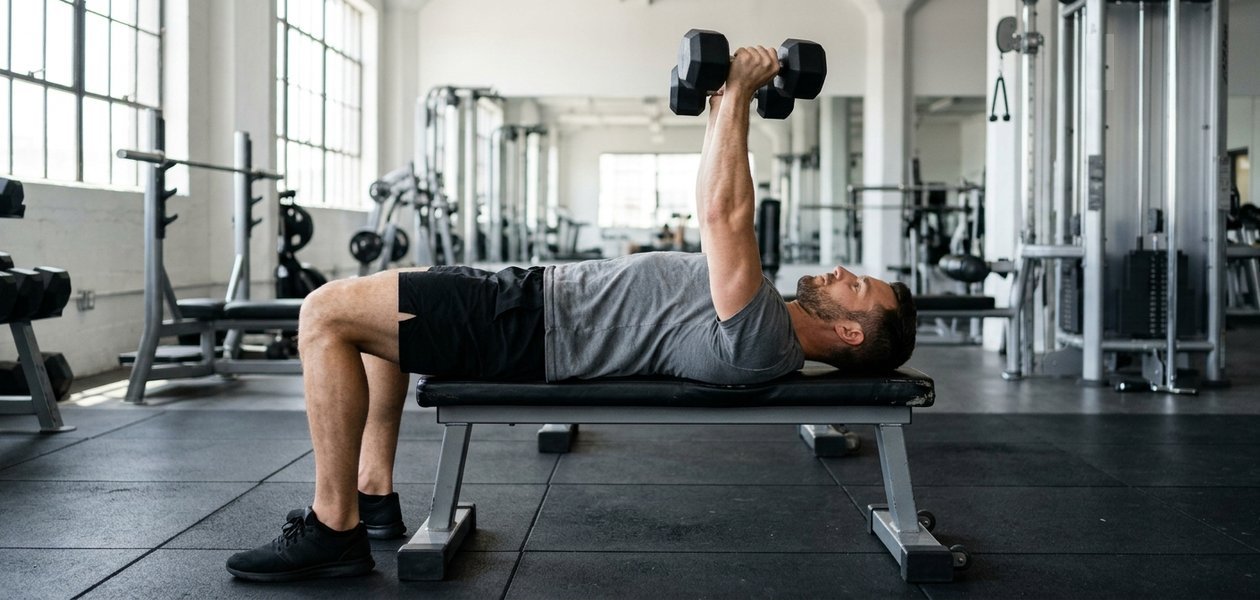
Because the two dumbbells are not joined, this version of the bench press asks more of the small stabilizing muscles than a barbell does. It also gives a longer range of motion, with the hands free to travel a little deeper at the bottom and closer together at the top.
Muscles the Dumbbell Press Works on a Flat Bench
In a dumbbell press, the prime mover is the pectoralis major, the large fan-shaped muscle across the chest. Because the lift bends both the shoulder and the elbow, it counts as a compound exercise, and two helpers plus a few smaller stabilizers share the work:
- Pectoralis major: pulls the upper arms toward the midline as the dumbbells rise, with the middle and lower fibers doing most of the work on a flat bench.
- Anterior deltoid: the front of the shoulder, which helps the chest drive the dumbbells up and forward.
- Triceps brachii: straightens the elbows, mostly in the top half of each press.
- Biceps and rotator cuff: hold each dumbbell steady so it does not drift or tip.
A 2017 systematic review of 14 bench press EMG studies in PLOS ONE found the chest and triceps working at similar levels, both well above the front deltoid. Those studies used a barbell.
For the dumbbell bench press, researchers in the Journal of Sports Science and Medicine point to earlier work showing more biceps activity than with a bar, likely because each elbow has to be held in line on its own.
How to Do a Flat Dumbbell Press, Step by Step
A set can go wrong before the first rep, when the dumbbells come off the floor. This sequence keeps the shoulders out of awkward positions from start to finish:
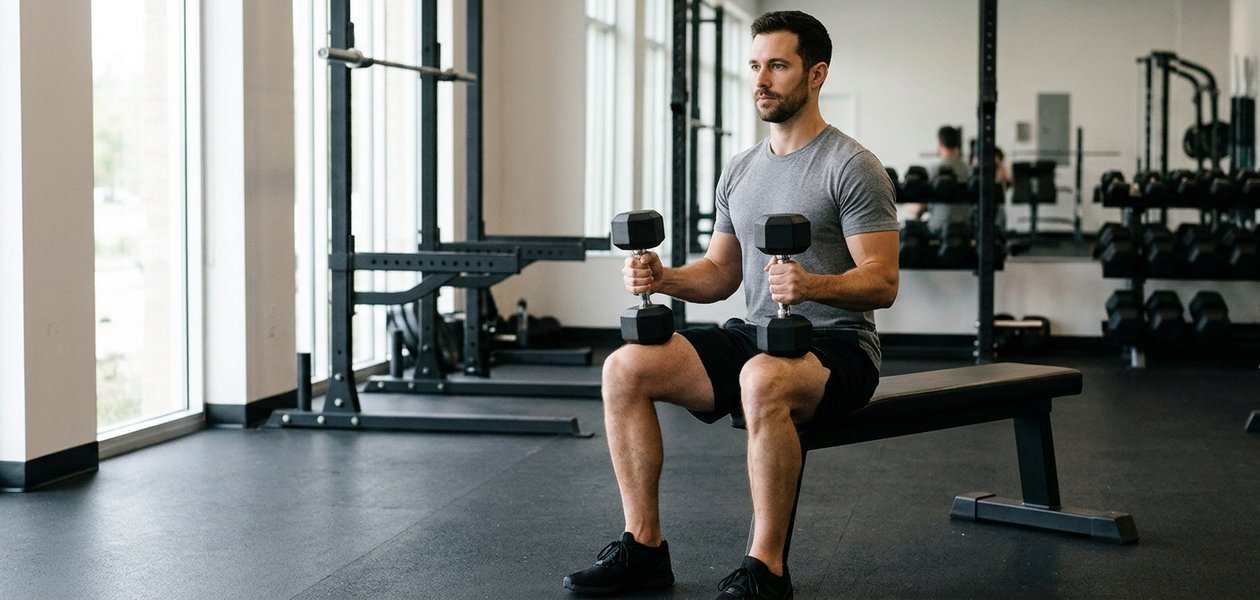
- Sit with a dumbbell on each knee. Sit on the end of a flat bench with one dumbbell standing upright on each knee.
- Roll back and kick them up. Lie back while lifting one knee at a time to push each dumbbell toward the shoulders, so the arms never lift the load from a dead stop.
- Set a stable base. Plant both feet flat, pull the shoulder blades down and back into the pad, and keep the hips and head on the bench.
- Start from straight arms. Press both weights over the chest until the elbows are almost locked, the dumbbells a few inches apart.
- Lower with control. Let the dumbbells sink to the sides of the chest, forearms vertical and elbows about 45 degrees out from the torso, until a stretch is felt across the pecs.
- Drive back up. Press up and slightly inward so the dumbbells finish over the shoulders, breathing out through the hardest part.
- Get down safely. After the last rep, bring the dumbbells to the chest, pull the knees up and rock back to sitting instead of dropping the weights.
Elbow Angle, Grip and Depth on a Dumbbell Press
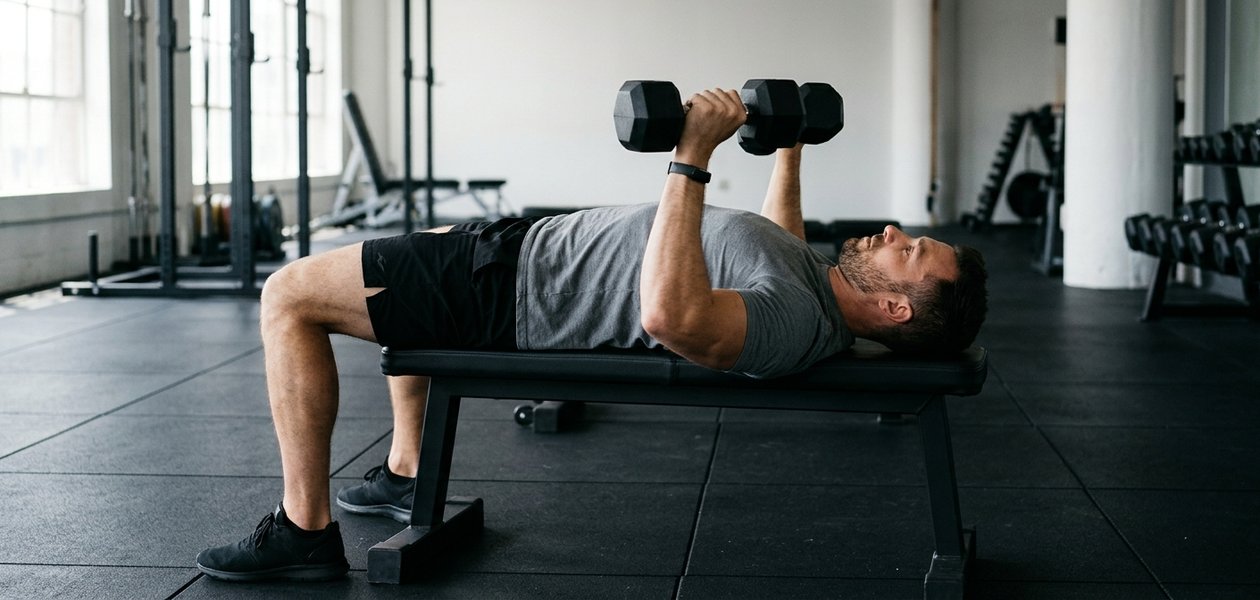
On any dumbbell press, coaches cue a 45 degree elbow angle, because flaring the arms out to 90 degrees shifts strain toward the front of the shoulder. In a 2024 Frontiers in Physiology study of 21 barbell bench press variations, a medium or narrow grip with the shoulder blades pulled back lowered compression and shear forces in the shoulder.
The dumbbell bench press makes that easy to apply, since the hands can settle wherever the joint is most comfortable. Holding the dumbbells palms forward lets the elbows sit wider, while a neutral grip, palms facing each other, keeps them closer to the ribs.
For depth, lower the dumbbells until the handles are about level with the chest or a firm stretch is felt, and stop short of any pinch in the shoulder.
Dumbbell Press Mistakes That Pull Work Away From the Chest
- Elbows flared to 90 degrees: the front deltoid takes over the press and the shoulder joint takes more stress.
- Clanking the dumbbells at the top: bouncing them together costs control, so stop them a few inches apart.
- Hips lifting off the bench: a slight arch is normal, but raising the hips mid-press shortens the range and loads the lower back.
- Dropping into the bottom: letting gravity take the dumbbells removes tension from the chest and jars the shoulder; a two second descent keeps it controlled.
- A pair too heavy to get into position: if the dumbbells cannot be kicked up, the set is lost before it begins.
Dumbbells or a Barbell: How the Two Bench Presses Compare
Neither tool wins outright. The barbell moves the most total weight, while a pair of dumbbells trades some load for range, balance work and freedom at the shoulder.
| Factor | Dumbbell bench press | Barbell bench press |
|---|---|---|
| Weight handled | Usually less in total, since each arm steadies its own dumbbell | Usually the heaviest load a lifter can press |
| Range of motion | Hands can sink lower and come closer together at the top | The bar stops when it touches the chest |
| Stabilizer demand | Higher, with more biceps activity | Lower, since one bar links both hands |
| Left and right balance | Each side works alone, so a weaker arm cannot hide | The stronger side can carry more of the bar |
| Equipment | A pair of dumbbells and a bench | A bar, plates and a rack, ideally with safety arms |
Training with dumbbells still builds barbell strength. In a 2020 PLOS ONE trial, 35 resistance-trained men pressed twice a week for 10 weeks with dumbbells, a Smith machine or a barbell on a Swiss ball.
Every group raised its six-rep max in the trained exercise by roughly 23% to 39%, and its barbell bench press six-rep max by about 12% to 17% without practicing that lift.
Incline, Neutral Grip and Other Dumbbell Bench Variations
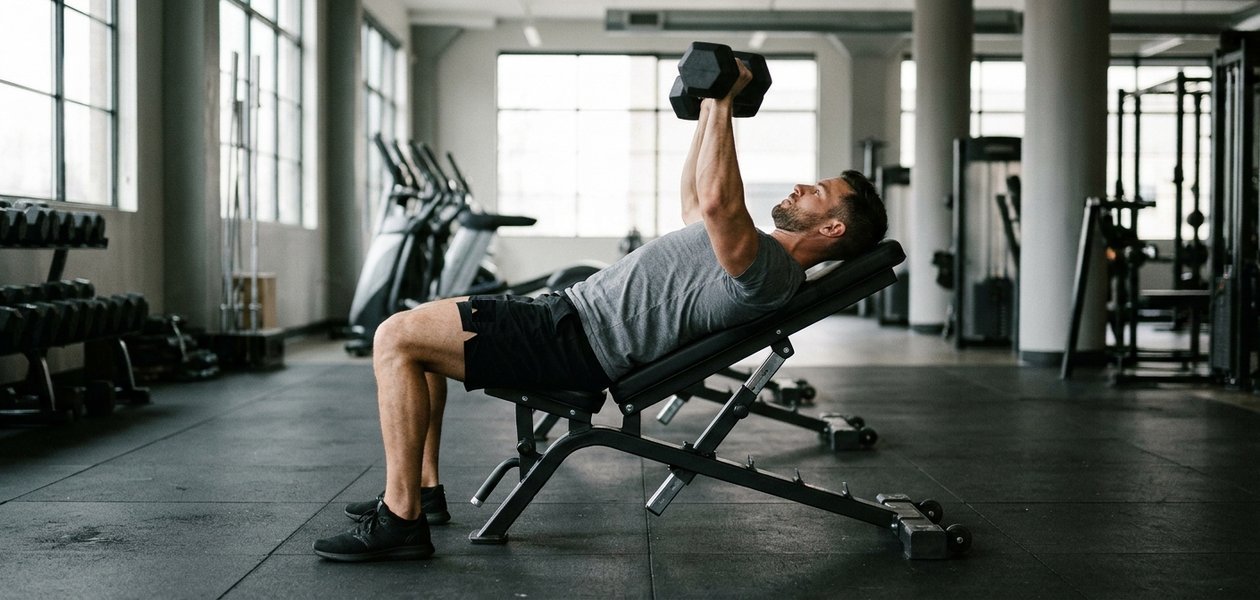
Raising the backrest moves the work toward the upper chest and shoulders. In a study of 30 trained adults pressing at five bench angles, upper chest activity peaked at 30 degrees, the middle and lower chest worked hardest flat, and the front deltoid peaked at 60 degrees.
- Incline dumbbell press at about 30 degrees: more upper chest without turning the lift into a shoulder press.
- Neutral grip dumbbell press: palms face each other and the elbows stay closer to the body, a common pick for touchy shoulders.
- Single-arm dumbbell press: one weight at a time, so the trunk has to resist twisting toward the loaded side.
- Dumbbell floor press: the floor stops the upper arms short, a shorter range for lifters without a bench.
Sets, Reps and Weight for the Dumbbell Press
The CDC’s activity guidelines for adults call for muscle-strengthening work on 2 or more days a week covering every major muscle group, and a dumbbell press covers the chest, front shoulders and triceps in one lift.
A 2021 review by Schoenfeld and Grgic tested the classic rep ranges, which apply to dumbbell pressing as to any lift:
- Strength: 1 to 5 reps at 80% to 100% of a one-rep max; heavy loads still lead here.
- Muscle size: 8 to 12 reps at 60% to 80%, which the authors call the most time-efficient route to growth.
- Endurance: 15 or more reps below 60%, though the evidence for a load effect is weak.
- Light but hard sets: similar growth from about 30% of a one-rep max upward, with effort mattering most at the light end.
For a chest workout built around the dumbbell bench press, sets of 8 to 12 reps make a practical default. The right pair can be kicked into position, lowered under control and pressed for every planned rep; when the top of the range feels easy on all sets, move up to the next pair.
