
For beginners, that short list covers almost everything needed in the first months of kettlebell training. The rest of this guide explains how to pick the size, how to learn the hinge that powers the swing, which ten moves to master in order, and how to build a weekly plan around them.
Why a Kettlebell Trains Strength and Conditioning Together
The handle sits above the ball, so the center of mass hangs beyond the hand instead of inside the grip. According to the Wikipedia entry on the kettlebell, that offset makes swinging movements possible and adds grip, wrist, arm and core work.
The conditioning effect is real and measurable. In a study of 14 young adults, swings done in Tabata intervals (eight rounds of 20 seconds of work and 10 seconds of rest) with an 8 kg bell for the men reached about 71% of peak oxygen uptake and a top heart rate near 162 beats per minute.
The research base is still thin, though. A 2019 scoping review of 99 kettlebell publications found effect sizes that were mostly trivial to small and rated the evidence for better physical function as weak. A bell is an efficient tool, not a shortcut.
Choosing the First Kettlebell Weight
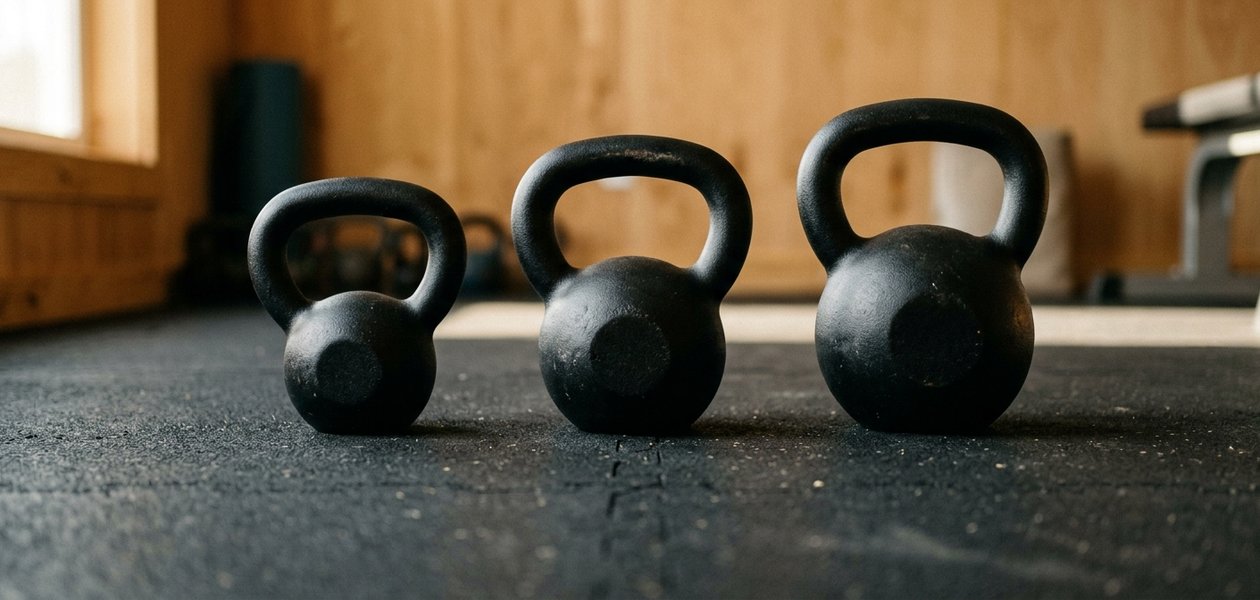
Most coaching advice points men to a 12 kg or 16 kg bell, with the lighter size for men who have never lifted. One US maker’s kettlebell sizing guide splits the choice by movement: explosive lifts such as swings and cleans take a heavier bell than slow grinds such as presses and get-ups.
| Starting point | Swings, cleans and snatches | Presses and get-ups |
|---|---|---|
| Inactive man, new to lifting | 12 kg (26 lb) | 8 kg (18 lb) |
| Average, active man | 16 or 20 kg (35 or 44 lb) | 8 to 12 kg (18 to 26 lb) |
| Athletic man | 16 to 24 kg (35 to 53 lb) | 12 to 20 kg (26 to 44 lb) |
A quick test settles the pressing size: the same guide suggests a bell that can be pressed overhead about 8 to 10 times. Because swings tolerate more weight than presses, the guide says a lifter needs two sizes to train both kinds of lift well, though one bell is enough to learn the patterns. Three details are worth checking before buying:
- Cast iron: the bell grows larger as the weight goes up, so the handle and ball change size from one bell to the next.
- Competition steel: every weight shares the same dimensions, and the same maker offers 33 mm and 35 mm handles.
- Pounds or kilograms: US shops often list pound sizes, and a 35 lb bell is the usual stand-in for 16 kg, close to the old Russian pood of 16.38 kg listed in the kettlebell history.
Learning the Hip Hinge Before the Swing
The swing is a hinge, not a squat. Lab work summarized in the 2019 review found that experienced lifters bend about 20 degrees more at the hips and about 15 degrees less at the knees than novices, and they swing the bell with the hips rather than lifting it with the shoulders.
The gap is hard to close without practice. Among 23 novices in one study cited by the review, none reached a fully upright hip at the top of the swing, falling short by an average of 9.7 degrees despite coaching. The kettlebell deadlift drills the same pattern slowly:
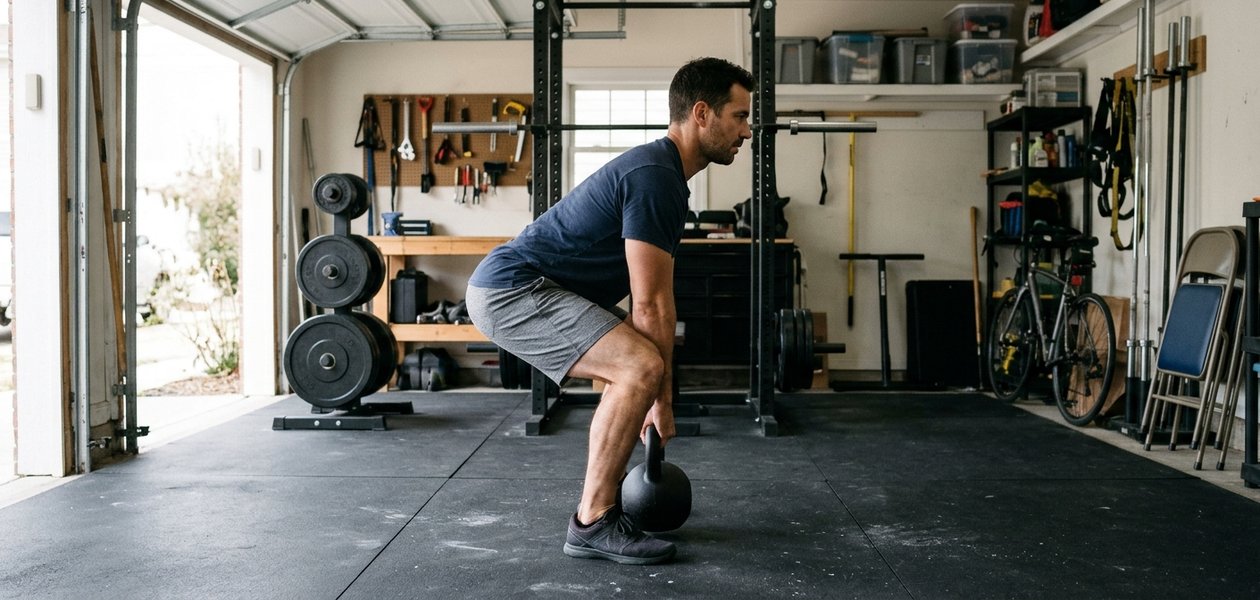
- Set the feet: stand with the feet about hip width apart and the bell on the floor between the arches.
- Push the hips back: keep the shins nearly vertical and send the hips toward the wall behind, letting the torso tip forward with a flat back.
- Grip and brace: take the handle with both hands, pull the shoulders down away from the ears and tighten the abs.
- Stand tall: drive the feet into the floor and bring the hips forward until the body forms a straight line, glutes squeezed.
- Lower the same way: hips back first, knees soft, and the bell guided down to the spot it started from.
Once ten smooth deadlifts feel automatic, the same motion becomes a swing. The bell is hiked back between the thighs, the hips snap forward, and the arms simply guide it up to chest height.
10 Kettlebell Exercises to Learn First
The order below suits beginners because it runs from the simplest pattern to the most demanding. Every move uses a single kettlebell, so the whole set fits a living room floor or a corner of the gym.
Hinge and Squat Patterns
1. Kettlebell Deadlift. The hinge described above, done for sets of 8 to 10. It loads the glutes and hamstrings and teaches the path of the bell before any speed is added.
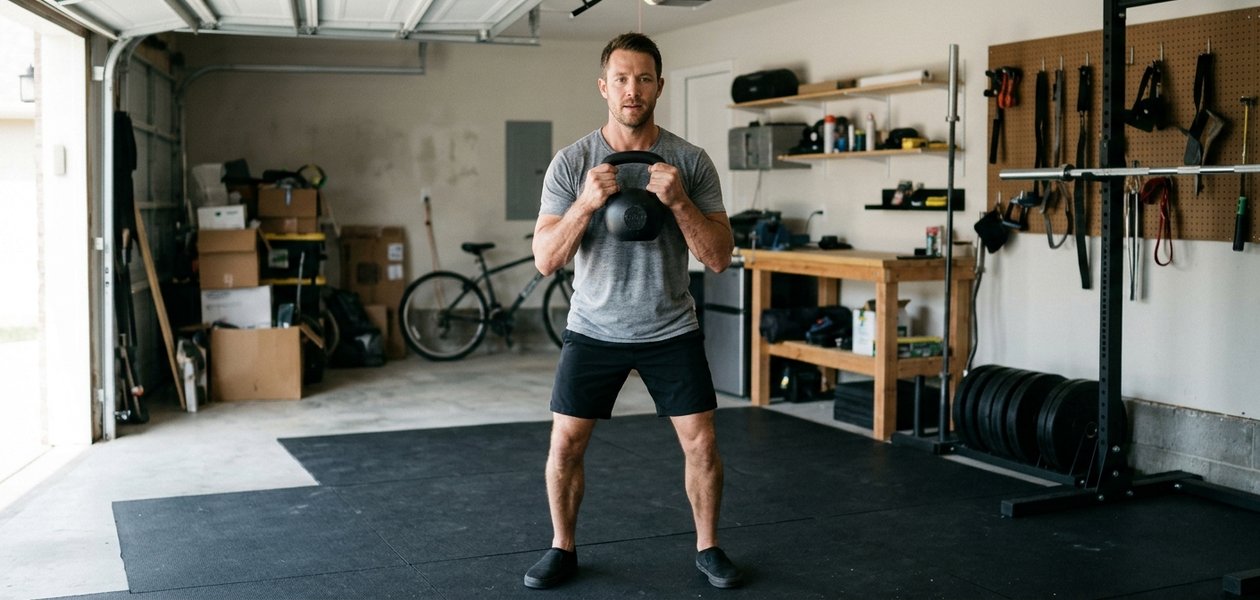
2. Kettlebell Goblet Squat. The bell is held by the horns at chest height with the elbows tucked, and the hips sit down between the heels while the chest stays up. The weight in front keeps the torso upright and makes depth easier to reach.
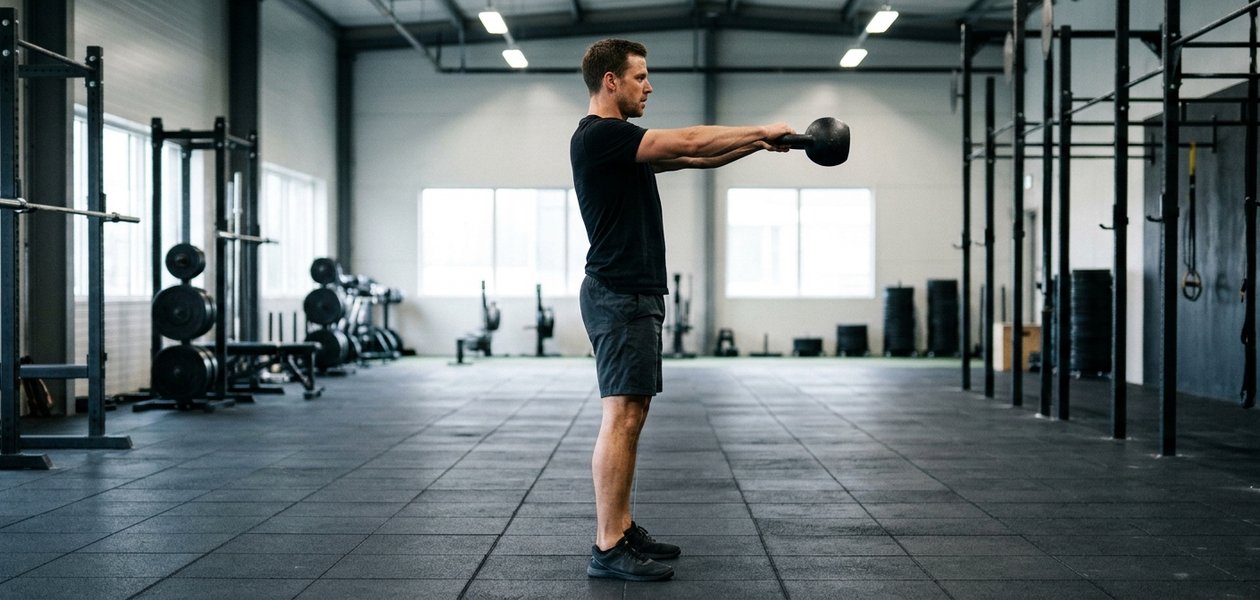
3. Two-Hand Kettlebell Swing. A hinge performed with speed. The arms act like ropes: the bell rises because the hips drive forward, and it should float no higher than the chest before falling back between the legs.
4. Kettlebell Reverse Lunge. Holding the bell at the chest, one foot steps back and the rear knee lowers toward the floor before the front heel drives the body up. Each leg works alone, which exposes any left to right difference.
Push and Pull Moves
5. Single-Arm Kettlebell Row. With one hand braced on a bench and a flat back, the bell is pulled toward the hip with the elbow close to the ribs, then lowered under control. It balances all the pressing with work for the upper back.
6. Kettlebell Floor Press. Lying on the back with the knees bent, the lifter presses the bell up from the chest. The floor stops the elbow at a safe depth, which makes it a sound first press for the chest and triceps.
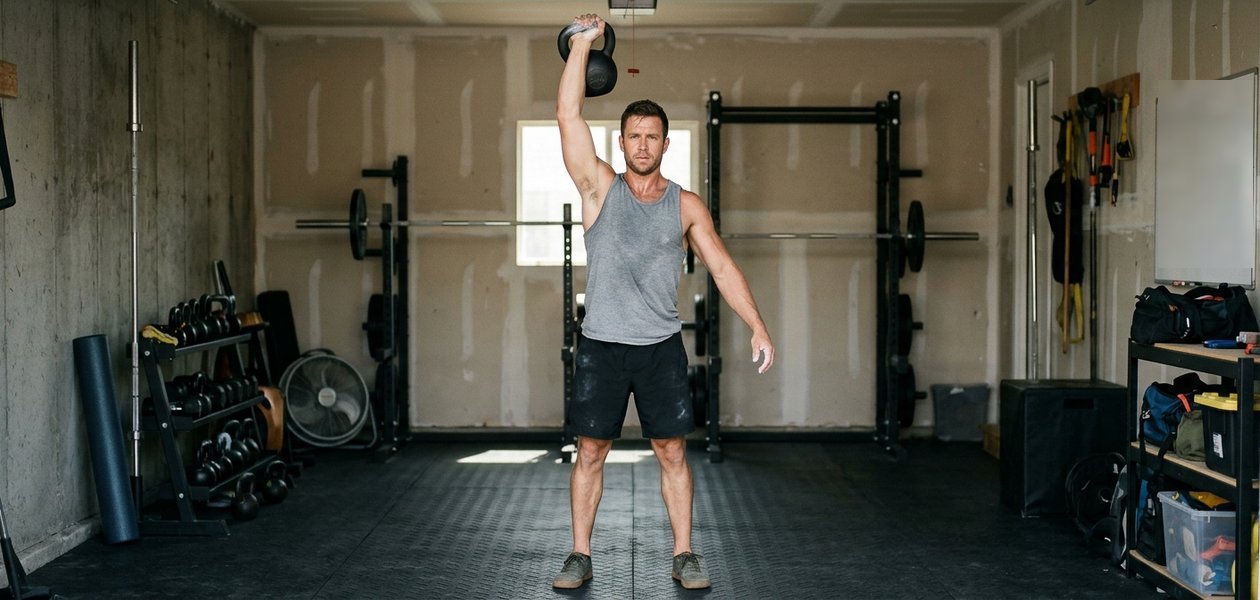
7. Single-Arm Kettlebell Overhead Press. The bell starts in the rack position, resting on the forearm against the chest, and travels straight up with the wrist stacked over the elbow. Glutes and abs stay tight so the lower back does not arch.
Carries, Core and Control
8. Kettlebell Halo. The bell is held upside down by the horns and circled slowly around the head in both directions. A light bell works the shoulders and upper back and doubles as a warm-up for pressing days.
9. Kettlebell Suitcase Carry. The lifter walks a set distance with the bell hanging at one side and the shoulders level. The trunk has to resist the sideways pull, so the core and grip both get stronger without any crunching.
10. Half Kettlebell Get-Up. From lying on the back with the bell pressed to the ceiling, the lifter rolls onto the opposite elbow, then the hand, and reverses the steps. It is the first half of the Turkish get-up, one of six fundamental hardstyle lifts named in the 2019 review alongside the swing, clean, press, squat and snatch.
A Two-Day Full-Body Starter Routine
Federal guidance sets the floor. The CDC’s adult activity overview calls for muscle-strengthening work on 2 or more days a week that covers the legs, hips, back, abdomen, chest, shoulders and arms. Two kettlebell sessions with a rest day between them meet that list.
The American College of Sports Medicine position stand on resistance training recommends loads in the 8 to 12 repetition maximum range and 2 to 3 training days a week for novices. The plan below sits inside both.
Day A focuses on strength:
- Kettlebell deadlift: 3 sets of 10 reps.
- Goblet squat: 3 sets of 8 reps.
- Single-arm row: 3 sets of 8 reps per side.
- Halo: 2 sets of 5 circles in each direction.
Day B adds speed and carries:
- Kettlebell swing: 5 sets of 10 reps.
- Floor press: 3 sets of 8 reps per side.
- Reverse lunge: 3 sets of 6 reps per leg.
- Suitcase carry: 3 walks per side.
Rest 60 to 90 seconds between sets. A five-minute warm-up of bodyweight squats, hip hinges and arm circles comes before each session, and the overhead press and half get-up join the plan once the floor press feels easy.
Sets, Reps and When to Move Up a Size
Progress comes in small steps. The ACSM stand advises a 2 to 10% load increase once a lifter can complete one or two reps beyond the target.
Competition bells come in 2 to 4 kg steps, so moving from 16 kg to 20 kg is a 25% jump. That is why extra reps and sets come before a heavier bell. Four signs show the next size is due:
- Reps to spare: every set finishes with one or two reps left in the tank, two sessions in a row.
- Clean last reps: the final swing of a set looks like the first, with no lean back at the top.
- A quiet press: the overhead press goes up without a side bend or help from the legs.
- A steady grip: the handle stays secure through every set of swings.
Too Much Weight Too Soon and Other Common Mistakes
Too much, too soon is the error to avoid first. Each of the three injury case reports collected in the 2019 review appears to trace back to a training load error, such as a sudden jump in how often or how hard someone trained. The technical faults below show up again and again in new lifters:
- Squatting the swing: deep knee bend turns the hinge into a squat and moves the work away from the hips.
- Lifting with the arms: raising the bell with the shoulders instead of letting the hips throw it.
- Leaning back at the top: the body should finish in a straight vertical line, not tilted backward.
- Rounding the back: picking the bell up with a curved spine instead of a hinge.
- Training every day: two or three sessions a week leave time to recover and learn the patterns.
Kettlebell Safety for Wrists, Forearms and Lower Back
Forearm bruising and discomfort from the bell striking the arm again and again are not unusual among novices, the 2019 review notes. A straight wrist and a bell that rolls around the hand rather than flipping over it take most of that impact away.
The lower back is less of a worry than many men assume. In the one study that measured spine loads, a two-handed swing with a 16 kg bell produced compression below the NIOSH action limit, a US workplace lifting benchmark, and about half the load of lifting 27 kg on a barbell, as the review summarizes.
That finding applies to healthy spines. Men with an existing back condition should still get cleared by a doctor or physical therapist before swinging, and these four habits make every session safer:
- Clear space: room in front and behind for the swing, with nobody walking past.
- Dry hands: chalk or a towel keeps a sweaty grip from slipping mid swing.
- Flat footing: flat shoes or bare feet give the hinge a stable base.
- Real coaching: the review advises novices to get proper instruction to avoid errors in technique or loading.
