
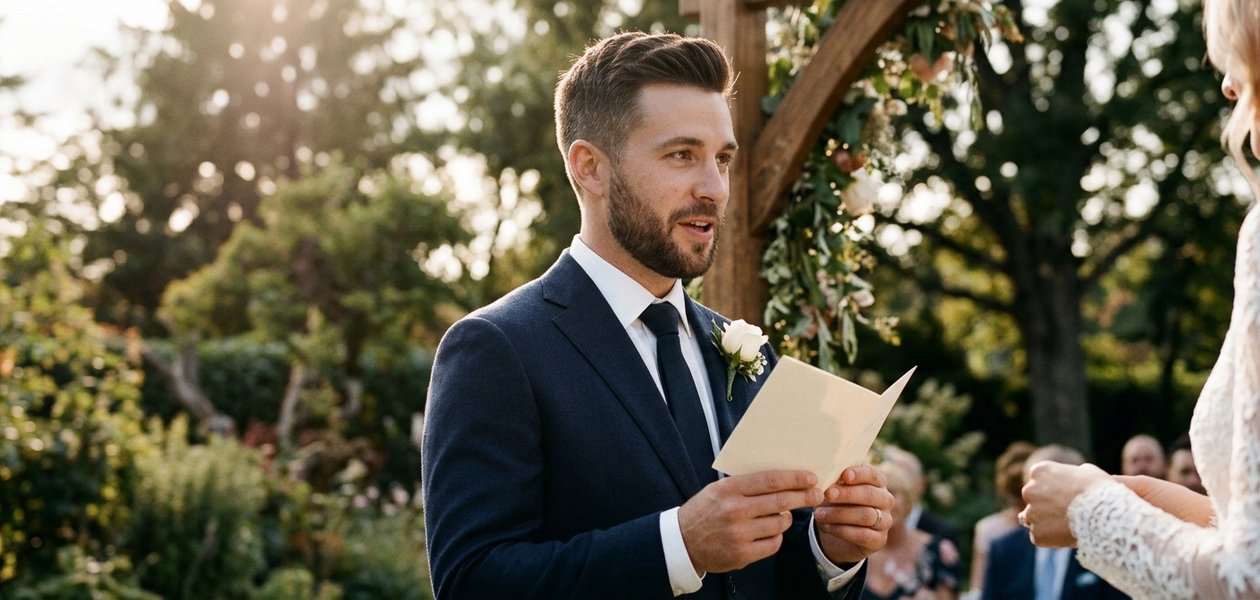
The 30 quotes below are sorted by the job a husband or groom needs them for: romantic words for vows and readings, wise words for the long years, funny lines for a toast or an anniversary card, and Bible verses read at weddings.
Each one was checked against the original book, poem, letter or interview, because the internet credits plenty of famous sayings to people who never said them. Where a line means something different in its original setting, the note under it says so.
Romantic Quotes for Wedding Vows and Readings
Ceremony readings lean on poetry and old novels because the language sounds formal without sounding stiff. These seven suit vows, a reading by a friend, or the inside of a wedding card.
1. “Let me not to the marriage of true minds / Admit impediments.” William Shakespeare, Sonnet 116. The poem goes on to call real love “an ever-fixèd mark / That looks on tempests and is never shaken,” a promise that suits a ceremony. The Folger Shakespeare Library prints the full sonnet with notes.
2. “How do I love thee? Let me count the ways.” Elizabeth Barrett Browning, Sonnet 43. The count runs from love “to the level of every day’s / Most quiet need” to a closing promise to “love thee better after death.” The Academy of American Poets keeps the complete poem online, and its 14 lines read aloud in well under a minute.
3. “What greater thing is there for two human souls, than to feel that they are joined for life…” George Eliot, Adam Bede (1859). The question goes on: “to strengthen each other in all labour, to rest on each other in all sorrow.” It closes the chapter where Adam and Dinah promise never to part, and the full chapter is free to read.
4. “I am my husband’s life as fully as he is mine.” Charlotte Brontë, Jane Eyre. Jane says it in the final chapter, after ten years of marriage to Edward Rochester, which makes it a line about a marriage that lasted rather than about a wedding day. The same paragraph adds, “No woman was ever nearer to her mate than I am.”
5. “Let there be spaces in your togetherness, / And let the winds of the heavens dance between you.” Kahlil Gibran, The Prophet (1923). The passage on marriage asks couples to “stand together yet not too near together,” because “the pillars of the temple stand apart.” Standard Ebooks has the whole book, and the passage works as a reading for couples who want one that is not scripture.
6. “Wheresoever she was, there was Eden.” Mark Twain, Eve’s Diary (1906). It is the last line of the book, spoken by Adam at Eve’s grave. Six words long, it fits a ring engraving or the first line of an anniversary card for a wife.
7. “Love does not consist in gazing at each other but in looking outward together in the same direction.” Antoine de Saint-Exupéry, Wind, Sand and Stars (1939), in Lewis Galantière’s English translation. Saint-Exupéry wrote it about comradeship among pilots, not about a husband and wife, yet its picture of two people facing the same way reads naturally at a wedding.
Wise Words on What Makes a Marriage Last
Writers from Homer to a 1978 newspaper interview keep landing on the same answer: a lasting marriage rests on friendship, fairness and a thousand small ties more than on passion. These lines work for an anniversary, a toast from an older couple, or a note during a hard season.
8. “There is nothing better in this world than that man and wife should be of one mind in a house.” Homer, The Odyssey, Book 6, in Samuel Butler’s translation. Odysseus says it to the young Nausicaa and adds that such a couple “discomfits their enemies” and “makes the hearts of their friends glad.” The Butler text is on Wikisource.
9. “A good marriage, if there be any such, rejects the company and conditions of love, and tries to represent those of friendship.” Michel de Montaigne, Essays, Book 3, Chapter 5, in Charles Cotton’s translation. Montaigne goes on to call marriage “a sweet society of life, full of constancy, trust,” and the whole essay rewards a slow read.
10. “There is no more lovely, friendly and charming relationship, communion or company than a good marriage.” Martin Luther, from Table Talk, the sayings his students noted at his dinner table between 1531 and 1546. It reads as warm and plain, a good fit for a church wedding program.
11. “A successful marriage requires falling in love many times, always with the same person.” Mignon McLaughlin, collected in The Complete Neurotic’s Notebook (1981). It suits a 10th, 25th or 50th anniversary card equally well, because the point grows truer with every year.
12. “Chains do not hold a marriage together. It is thread, hundreds of tiny threads which sew people together through the years.” Simone Signoret, the French actress, to David Lewin of the Daily Mail in 1978, when he asked what held her marriage to the actor Yves Montand together. Quote Investigator traced the interview and notes her next sentence: “But those threads should never become chains.”
13. “The independence of the husband and wife should be equal, and the dependence reciprocal.” Lucretia Mott, speaking at the National Women’s Rights Convention in 1853. She had used a fuller version in an 1841 speech, “our independence is equal, our dependence mutual, and our obligations reciprocal,” and later writers credited it to others, as this history of the saying shows.
14. “Where there’s marriage without love, there will be love without marriage.” Benjamin Franklin, Poor Richard’s Almanack, 1734. Franklin filled his yearly almanac with short sayings like this, many adapted from older collections, and the collected sayings include several more on courtship.
15. “Marriage has many pains, but celibacy has no pleasures.” Samuel Johnson, The History of Rasselas, Prince of Abissinia (1759), chapter 26. Princess Nekayah says it after weighing married and single life, and it makes an honest, slightly wry line for a couple who have weathered a few storms.
Funny Quotes for a Toast or Anniversary Card
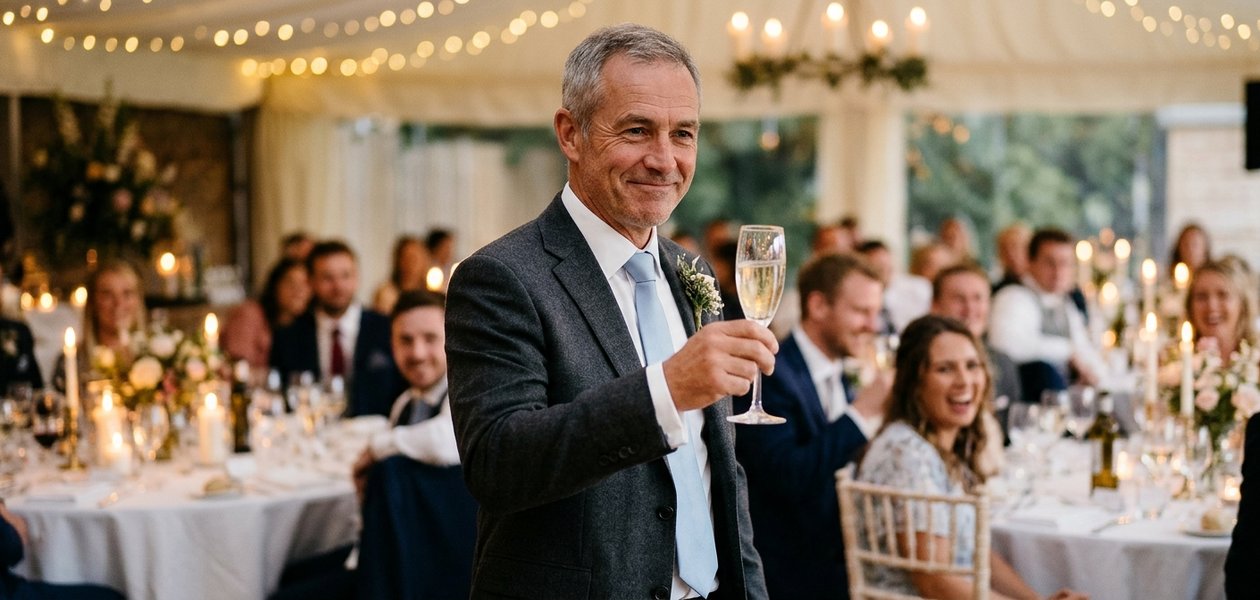
A funny line works when both spouses can laugh at it. The safest jokes poke fun at marriage itself, the shared chaos of two people under one roof, rather than at the wife or the husband. Every one of these eight has a real source.
16. “Marriage is popular because it combines the maximum of temptation with the maximum of opportunity.” George Bernard Shaw, Maxims for Revolutionists, part of the appendix to his play Man and Superman. It is printed in the Standard Ebooks edition under the heading “Marriage.”
17. “Men marry because they are tired; women because they are curious. Both are disappointed.” Oscar Wilde, A Woman of No Importance, Act 3. The cynic Lord Illingworth says it, and a young man asks him straight after whether anyone can be happy once married. Wilde gave a version of the same joke to Lord Henry in The Picture of Dorian Gray.
18. Niagara Falls “is the first disappointment in the married life of many Americans who spend their honeymoon there.” Oscar Wilde, in an 1883 interview with The New York World. The quip about the classic honeymoon spot was reprinted in other papers, and Wilde repeated it in his lectures.
19. A second marriage is “the triumph of hope over experience.” Samuel Johnson, speaking of a man who remarried right after an unhappy first marriage, as James Boswell recorded it in The Life of Samuel Johnson, under the year 1770. It is a gift for a toast at a second wedding, as long as the couple has the humor for it.
20. “Keep your eyes wide open before marriage, half shut afterwards.” Benjamin Franklin, Poor Richard’s Almanack, 1738. Read kindly, it is sound advice: look hard before choosing, then let the small faults go.
21. Marriage is “a legal and religious alliance entered into by a man who can’t sleep with the window shut and a woman who can’t sleep with the window open.” Ogden Nash, from his poem “I Do, I Will, I Have” in The Saturday Evening Post, May 1948. The joke is often credited to Shaw, but Quote Investigator found no evidence Shaw ever used it.
22. Marriage is “the alliance of two people, one of whom never remembers birthdays and the other never forgetsam.” Ogden Nash, from the same 1948 poem, with the invented rhyme left in. It is a near perfect line for an anniversary card from a husband who got the date right this year.
23. “Never go to bed mad. Stay up and fight.” Phyllis Diller, Phyllis Diller’s Housekeeping Hints (1966). The comedian bent the old newlywed advice about never going to bed angry, and her 1967 follow-up added that she and “Fang” once “were up for nine months.”
Bible Verses on Marriage Read at Weddings
Christian ceremonies return to a handful of passages. The wording below comes from the Berean Standard Bible, a modern translation its publishers placed in the public domain on April 30, 2023, so it can be printed on a program or card without permission.
One popular verse is left off on purpose. Ruth 1:16, “wherever you go, I will go,” is spoken by Ruth to her mother-in-law Naomi, not to a husband, so it reads better as a vow of loyalty than as a line of romance.
24. “For this reason a man will leave his father and mother and be united to his wife, and they will become one flesh.” Genesis 2:24. It closes the Bible’s account of the first man and woman, and Jesus quotes it in Mark 10:7 and 8.
25. “Therefore what God has joined together, let man not separate.” Mark 10:9. Jesus says it in reply to Pharisees who asked whether a man may divorce his wife, which gives the line its weight as a vow.
26. “Two are better than one, because they have a good return for their labor.” Ecclesiastes 4:9. The next verse explains why: “if one falls down, his companion can lift him up.” The passage ends with “a cord of three strands is not quickly broken,” a picture of strength in union that suits a wedding.
27. “Mighty waters cannot quench love; rivers cannot sweep it away.” Song of Solomon 8:7. The book is a love poem in which the man calls the woman “my bride.” The verse just before it opens with “Set me as a seal over your heart, as a seal upon your arm,” and the two together make a strong closing for vows.
28. “Love is patient, love is kind. It does not envy, it does not boast, it is not proud.” 1 Corinthians 13:4. Paul wrote the chapter to the church in Corinth, not to a couple, and the word he used is the Greek agape, a chosen love that asks nothing back.
That background makes the passage stronger at a wedding, not weaker: it describes love as a set of choices. Verse 7 adds that love “bears all things, believes all things, hopes all things, endures all things.”
29. “He who finds a wife finds a good thing and obtains favor from the LORD.” Proverbs 18:22. Short and direct, it is a strong line for a groom’s toast or a card to a new husband from his father.
30. “Husbands, love your wives, just as Christ loved the church and gave Himself up for her.” Ephesians 5:25. It sets the standard for a husband as self-giving love, not control, and suits a groom’s vows. A wider set of verses for men in a relationship sits in a separate guide.
How to Use a Quote in a Wedding Speech, Vows or Card
The right line depends on the room and the reader. A sonnet that moves a church can fall flat at a loud reception, and a Wilde joke can sting in a card to a wife on a bad week. Four habits keep a borrowed line working for the man who uses it:
- Match the setting. Scripture, Shakespeare and Gibran suit the ceremony; Shaw, Nash and Diller belong in the reception toast, where the crowd expects a laugh.
- Use one line, not five. A quote opens the door; the speech or card should be about the couple, so follow it straight away with something only the speaker could say.
- Credit the right person. Check the source before printing a name on a program or a card, since many popular lines carry the wrong author.
- Add one specific memory. A sentence about the night they met or the house they fixed up turns a famous line into a personal one.
Here is how that looks in practice, with each borrowed line followed by a sentence of the speaker’s own:
From a best man: “Ogden Nash called marriage an alliance between a man who can’t sleep with the window shut and a woman who can’t sleep with the window open. Tonight, the window is her call.”
In an anniversary card: “Mignon McLaughlin wrote that a successful marriage means falling in love many times, always with the same person. Twelve years in, still the same person.”
In a groom’s vows: “Mark Twain gave Adam the last word: wheresoever she was, there was Eden. From today, wherever she is, that is home.”
For a text or a card on an ordinary day, the short ones work best: Twain’s six words on Eden, McLaughlin on falling in love again, or Proverbs 18:22. Timing matters as much as wording, and a line sent after a hard week can mean more than the same line on a birthday.
Lines Often Credited to the Wrong Person
The best known example is the joke credited to Socrates: “By all means marry. If you get a good wife, you’ll become happy; if you get a bad one, you’ll become a philosopher.” Its origin is unknown: no ancient text has it, and the printed versions researchers have found date from the 1930s onward.
The closest real record is in Diogenes Laertius, whose Lives of the Eminent Philosophers reports that when someone asked Socrates whether to marry, he answered, “Whichever you do you will repent it.”
Jane Austen gets credit for “Happiness in marriage is entirely a matter of chance,” but in Pride and Prejudice the line belongs to Charlotte Lucas, and Elizabeth Bennet answers at once that it “is not sound.” Printing it under Austen’s name on a wedding card gets both the author and the meaning backward.
Nash’s window joke, as noted above, is pinned on Shaw. Signoret’s line about threads is the reverse case: people question it, yet the 1978 interview confirms she said it. When a line matters, a minute spent on the original source saves an awkward correction from a well read guest.
