
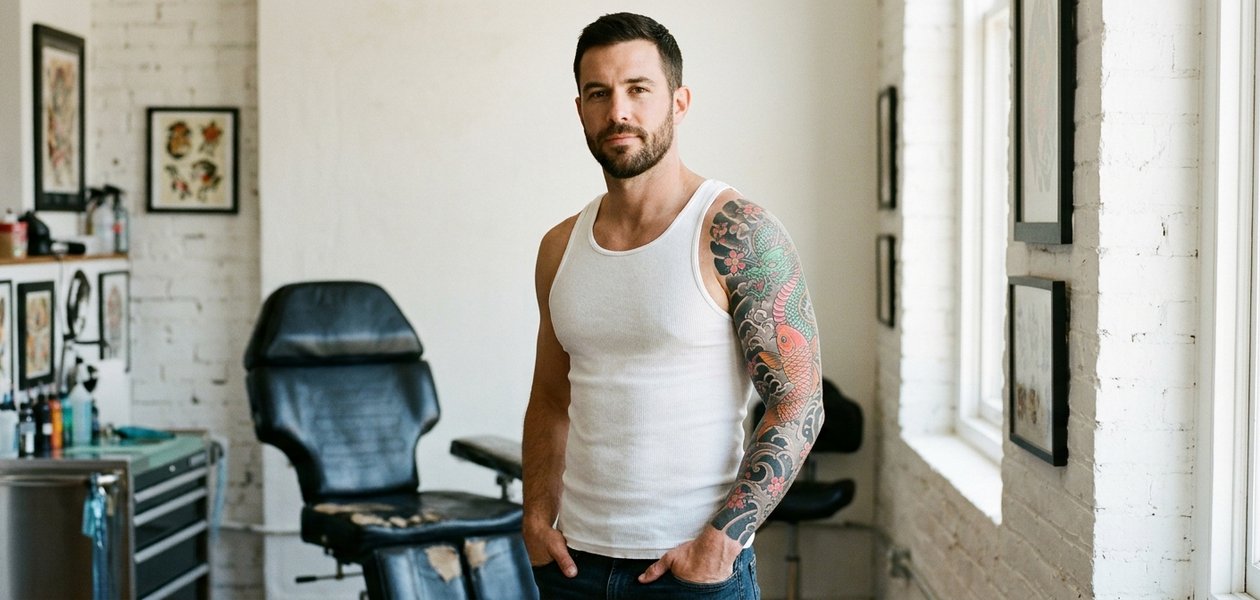
The 25 sleeve tattoo ideas below, chosen for a man’s arm, are grouped by style, from Japanese irezumi to biomechanical work, with the coverage each one suits. After them come planning the flow, pain, sittings, cost and healing. Arm work is common ground: 27% of American men have at least one tattoo, according to a 2023 Pew Research Center survey.
Full, Half and Quarter Sleeves Compared
Size decides how much of the design shows at work, how many sittings it takes and which subjects fit. In Japanese tattooing a nagasode runs to the wrist and a shichibu stops at the middle of the forearm, according to the glossary of irezumi terms.
| Sleeve | Where it runs | Hidden by a T-shirt? | Subjects that fit |
|---|---|---|---|
| Quarter | Shoulder cap to the middle of the upper arm | Yes | One animal head, a portrait, a mandala |
| Half (upper arm) | Shoulder to the elbow | Mostly, the lower edge can peek out | A dragon, a lion, a religious scene |
| Half (forearm) | Elbow to the wrist | No | Lettering, a clock, a long snake or koi |
| Three quarter | Shoulder to the middle of the forearm | No | A Japanese scene that can grow |
| Full | Shoulder to the wrist | No | One large theme with background filler |
An upper arm half sleeve suits a man with an office job, since a short shirt sleeve covers most of it. A forearm half sleeve is the opposite choice: the design is on show every time he rolls up his cuffs.
Japanese Irezumi Sleeves: Dragons, Koi and Waves
Traditional Japanese work treats the arm as one painting. Its large subjects sit on a background of clouds, waves or wind bars that ties every element together, which is why irezumi suits a full arm so well.
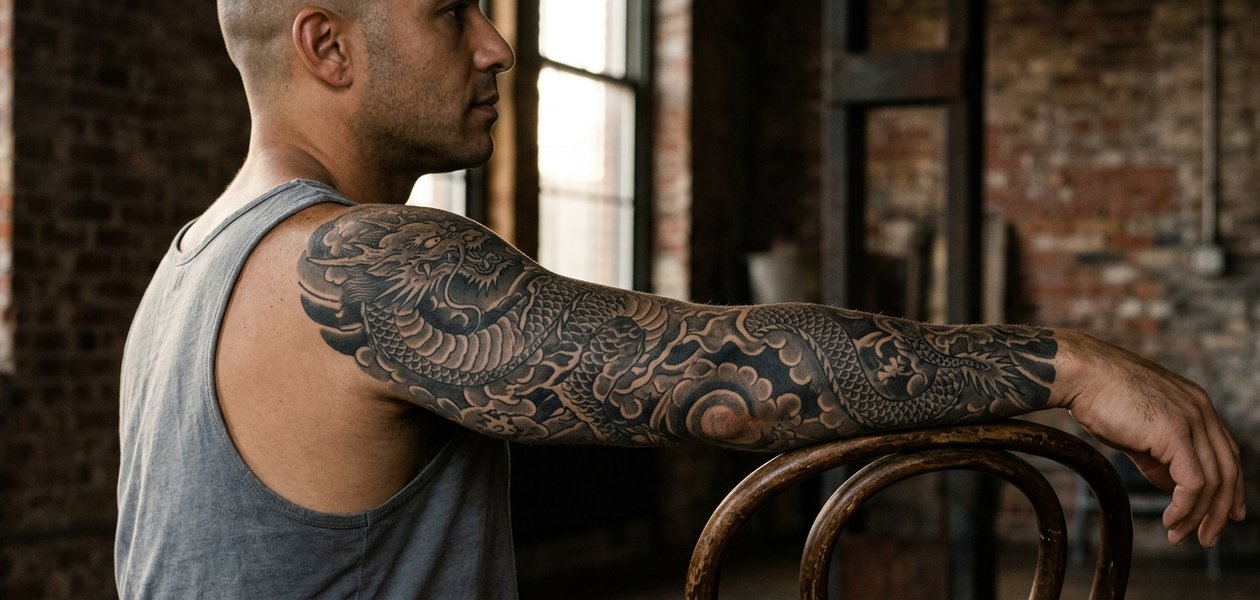
1. Dragon sleeve. A dragon coiling from the shoulder to the wrist uses the whole arm, its head on the outer bicep or shoulder cap where it reads first.
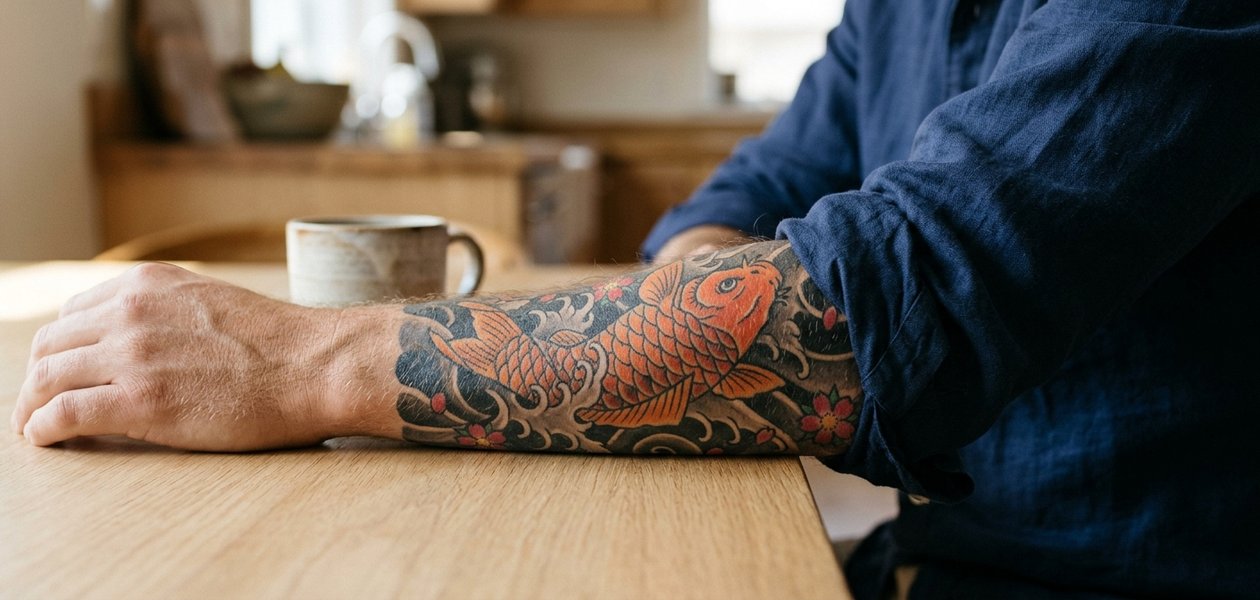
2. Koi climbing a waterfall. A koi swimming upstream through heavy waves stands for perseverance. Two koi swimming in opposite directions balance a forearm half sleeve; more water ideas sit in these wave designs.
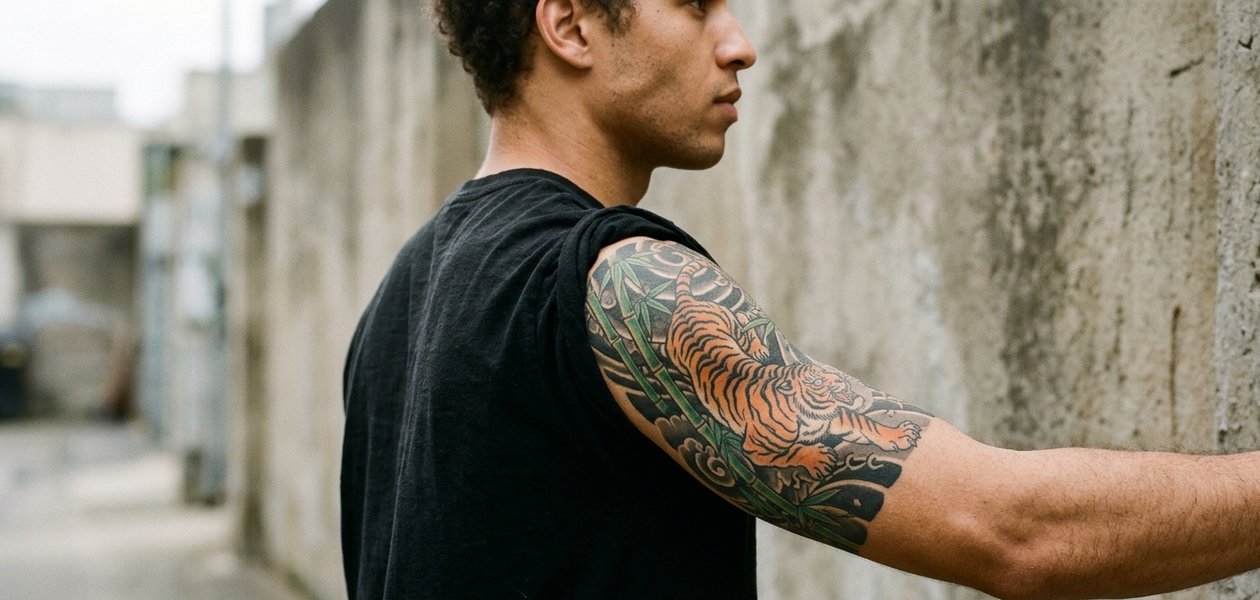
3. Tiger in bamboo. A tiger crouched among bamboo fills the upper arm, and the vertical stalks carry the eye down toward the elbow.
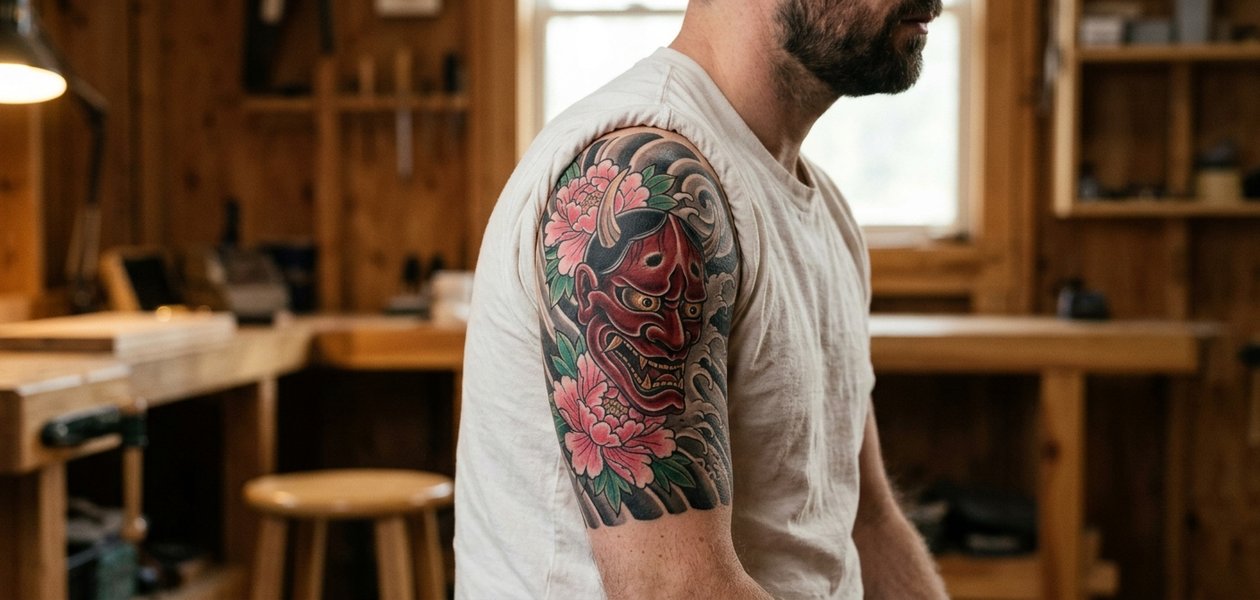
4. Hannya mask with peonies. The horned Hannya mask comes from Noh theater. Framed by peonies and wind bars, it makes a compact upper arm piece that can grow into a full arm.
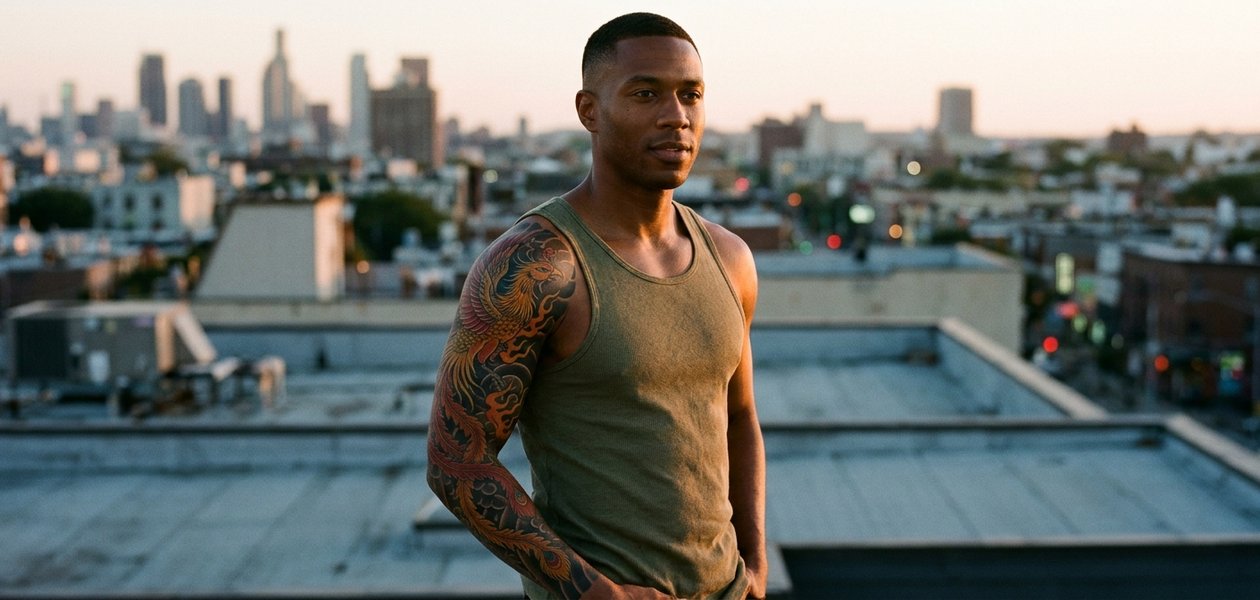
5. Phoenix (Hō-ō) in flames. The Japanese phoenix spreads its long tail feathers down the arm, so it suits a three quarter or full sleeve.
6. Cherry blossoms and chrysanthemums. Blossoms falling through waves or clouds join the bigger subjects, and they can carry a whole forearm on their own.
The style grew out of woodblock prints: the 1757 Japanese edition of the novel Suikoden showed heroes covered in dragons, tigers and flowers, and readers wanted the same on their skin. A sleeve can also continue onto the chest as a hikae, a panel across both pecs, as these chest panel designs show.
Black and Grey Realism Sleeves: Lions, Wolves and Portraits
Realism uses smooth black and grey shading to make a subject look like a photograph. The shading needs room, so the subject usually sits on the outer upper arm or the forearm, where the skin is flattest.
7. Lion portrait. A lion’s face on the outer upper arm, its mane fading into smoke, is a common realism subject and a long standing symbol of leadership.
8. Wolf and forest. A wolf’s head over a misty pine forest gives a full arm one theme: the animal in front, the landscape filling the rest.
9. Clock and rose. A pocket watch with a rose marks time and loss. The round face sits best on a flat stretch of forearm, away from the twist near the wrist.
10. Family portrait. A realistic portrait of a parent or child is the most personal subject here. In the Pew survey, 63% of tattooed men named honoring or remembering someone or something as a reason for their ink.
11. Praying hands and angel. Praying hands, an angel or Archangel Michael read well in black and grey and often anchor a faith themed upper arm.
12. Greek god statue. A marble style bust of Zeus or Poseidon turns the arm into a sculpture gallery, with cracked stone to shade.
Tribal, Polynesian and Geometric Blackwork Sleeves
These styles work with pattern rather than pictures. Solid bands and shapes wrap around the arm instead of facing one way, so the sleeve looks finished from every angle.
13. Polynesian band sleeve. Bands, triangles and dense black run from the shoulder down the arm. Samoa has an unbroken tattooing tradition, and its men’s pe’a uses symmetrical bands, lozenges, dots and triangles, according to Oxford’s Pitt Rivers Museum. An accurate piece needs an artist who knows the tradition.
14. Neo tribal blackwork. Modern tribal drops the old flames for sharp, flowing black shapes that follow the muscles of the shoulder and forearm.
15. Sacred geometry. Mandalas, hexagons and repeating triangles build a sleeve with clean symmetry that can wrap all the way around the forearm.
16. Dotwork. Shading made of thousands of tiny dots gives geometric work a soft gradient without hard shading lines.
17. Patchwork tied with blackwork. A man with scattered small tattoos can join them with solid black fill or geometric bands, turning the gaps into one connected sleeve.
Traditional, Neo-Traditional and Chicano Sleeves
American traditional work uses heavy outlines and a few solid colors, a style made to stay readable on skin for decades.
18. American traditional patchwork. Swallows, anchors, panthers, daggers and roses placed as separate pieces, then joined by small fillers, build a sleeve one sitting at a time.
19. Neo-traditional animal. Neo-traditional keeps the bold lines but adds richer color and dimensional shading. An owl, a stag or a fox framed by flowers suits it.
20. Chicano black and grey. Fine shading, script lettering, roses and religious figures define the Chicano style, often built around a portrait or a family name.
21. Nautical sleeve. A ship in a storm, a compass and a lighthouse tell one story down the arm, from open water at the shoulder to the harbor at the wrist.
Norse, Nature and Biomechanical Sleeve Themes
Theme sleeves pick one subject and let every element serve it, so a large piece never looks like a scrapbook.
22. Norse and Viking. Odin’s ravens, a longship, the world tree Yggdrasil and bands of runes give a strong single theme, with knotwork filling the gaps.
23. Forest and mountains. Pine trees climbing from the wrist to a mountain range on the shoulder turn the arm into one landscape, with mist as the filler.
24. Space and planets. Planets, a moon and a starfield wrap the arm easily, since space has no fixed up or down.
25. Biomechanical sleeve. Pistons, cables and gears that seem to sit under torn skin follow the style the Swiss artist H. R. Giger called biomechanical, a blend of human bodies and machines. Tracing the real forearm muscles makes the illusion convincing.
Building One Cohesive Theme That Follows the Arm
The best sleeves read as one piece rather than a collection of stickers. A few planning rules keep it that way:
- Pick one theme or style first. A single story, such as Japanese mythology or a landscape, gives every later sitting a direction.
- Choose a specialist. An artist whose healed work already shows that style will plan the whole arm, not just the first piece.
- Put the main subject on the outer arm. The outer bicep and the top of the forearm are the flattest, most visible spots.
- Keep faces off the elbow. The joint folds and bends, so portraits and lettering placed there distort.
- Plan for the forearm twist. The forearm rotates, so straight lines and clock faces look true only in one position.
- Decide the lower edge. A half sleeve that ends where his shirt sleeves end stays hidden at work.
- Save space for filler. Clouds, waves, smoke or black fill join the main pieces and close the gaps.
Pain, Sessions and Cost of a Full Sleeve
The arm is one of the easier places to be tattooed, but a sleeve crosses several pain zones. The Healthline tattoo pain chart sorts them like this:
- Upper arm and shoulder: low to moderate pain, thanks to padding and tight skin.
- Forearm: low to moderate pain on most of its surface.
- Inner bicep and armpit: high to severe pain, where the skin is thin and nerve endings are many.
- Inner or outer elbow: high to severe pain, with the needle working close to bone.
- Wrist: high to severe pain, for the same reason.
Time adds its own pain: Healthline notes a burning feeling builds when one area is worked for a long stretch, one reason a sleeve is split into several sittings.
Most artists bill by the hour or by the day, so detail, color and the artist’s demand set the price. At the extreme end, a traditional Japanese body suit covering the arms, back, thighs and chest can take up to five years of weekly visits and cost more than US$30,000, according to Wikipedia’s irezumi entry.
Healing a Sleeve and Keeping the Shading Sharp
A large tattoo heals more slowly than a small one. The aftercare guide from Cleveland Clinic, built with dermatologist Shilpi Khetarpal, says the top layer of skin is typically healed by about the two month mark, while deeper layers need several more months. Its routine applies to each new section:
- Wash twice a day with mild, fragrance free soap and warm water, then pat dry.
- Moisturize twice a day so the skin does not crack.
- Wear loose sleeves that let the skin breathe and do not rub.
- Leave scabs alone and let them fall off by themselves.
- Stay out of pools and hot tubs until the skin has fully healed.
- Keep it out of the sun, since UV rays fade ink and leave a washed out look.
Arms see more sun than most tattooed skin, and UV keeps fading ink after healing. Bold outlines and strong black and grey contrast stay readable longest.
The ink deserves a thought too. The FDA has not approved any pigment for injection into the skin and has received reports of ink reactions right after tattooing and years later. A good studio can name the brand and batch of every ink it used.
A sleeve is also hard to undo. About 24% of tattooed Americans regret at least one tattoo, Pew found, and the American Academy of Dermatology explains that laser removal takes several sessions because the ink sits in layers. Time spent on the design before the first sitting is cheap insurance.
