
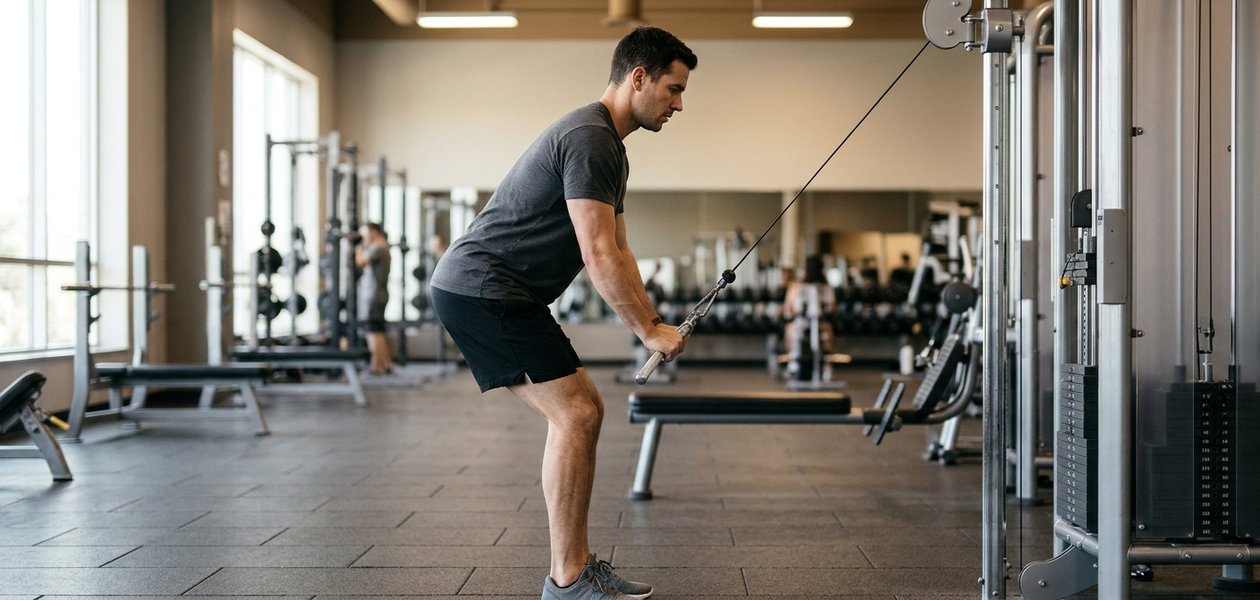
Rows and seated pulldowns bend the elbows, and many lifters feel their arms tire long before their backs do. Locking the elbow angle removes that help and leaves one action, the arm moving down and back at the shoulder, which is the main job the lats perform. Some gyms call the same move a straight-arm pushdown or a standing cable pullover.
Setting Up the Cable, Attachment and Stance
The pulldown starts with the pulley at its highest notch, or just above head height, and a straight bar, an EZ bar or a rope clipped on. A bar takes an overhand grip about shoulder width apart, and a rope takes a neutral grip with the palms facing each other.
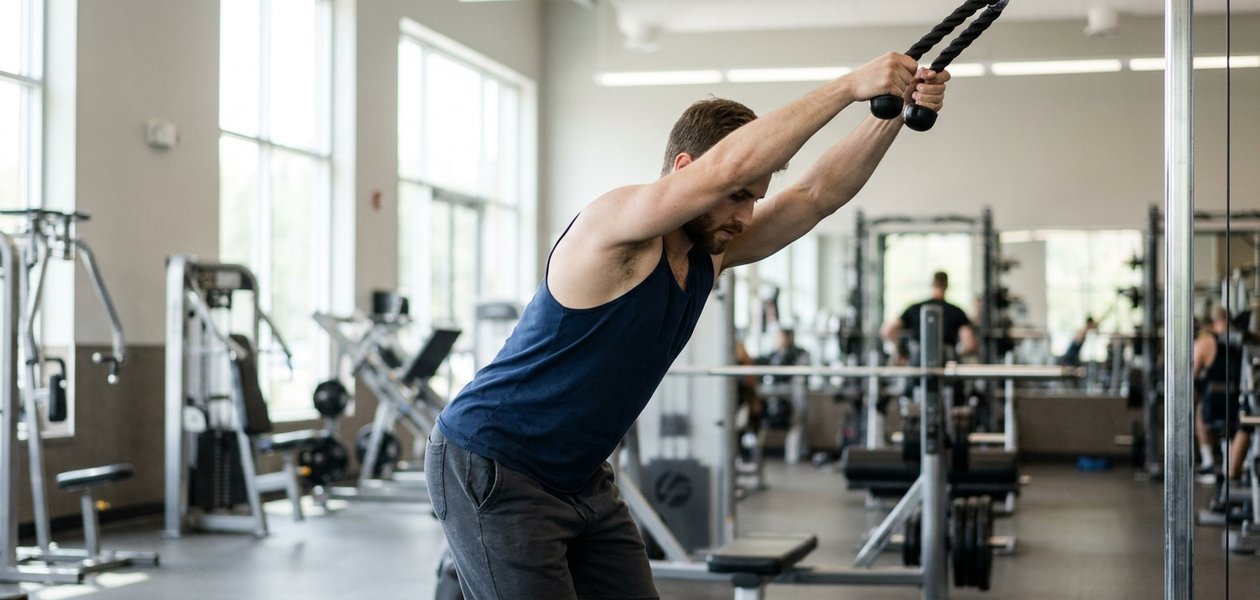
Take the handle, then walk back until the plates lift with the arms still extended overhead. Stand with the feet about hip width apart, soften the knees and brace the abs. Hinge forward roughly 30 to 45 degrees at the hips with a neutral spine, chest up and shoulders pulled down away from the ears.
Step-by-Step Form: Sweep the Bar Down in an Arc
- Start long: with the arms reaching overhead in line with the torso, let the lats stretch without letting the shoulders shrug up.
- Set the elbows: keep a slight bend and hold it; the angle that starts the rep is the angle that finishes it.
- Sweep down in an arc: exhale and drive the hands down and back toward the thighs, moving only at the shoulders, as if pressing the bar into the front of the legs.
- Squeeze at the thighs: pause for about one second with the bar at or near the thighs and the chest still tall.
- Return under control: inhale and let the bar rise along the same path over two or three seconds until the arms are overhead again, with the plates never resting on the stack.
Keeping Tension on the Lats at the Bottom of the Arc
Near the thighs, the cable can end up running almost parallel to the arms, and the lats then get little resistance even during a hard squeeze. Turning force depends on angle: a force aimed straight along a lever toward its pivot produces no torque, as OpenStax College Physics shows with a door pulled toward its hinges.
The fix is distance. Stepping farther back from the pulley keeps the cable at an angle to the arms through the bottom of each straight-arm pulldown. The bottom deserves the load: in an isometric study of 15 resistance-trained men, lat activity was highest with the upper arm between 0 and 45 degrees from the side of the body.
Pulldown Muscles Worked: Lats, Teres Major and Triceps
Anatomy references list the actions of the latissimus dorsi as extension, adduction and internal rotation of the arm. Cleveland Clinic calls the lats the largest muscles in the upper half of the body. Bringing the arms from overhead to the thighs is shoulder extension, so the straight-arm pulldown loads them over a long range.
- Latissimus dorsi: the prime mover, pulling the upper arm from overhead down to the thighs through the whole arc of the straight-arm pulldown.
- Teres major: a thick muscle from the lower corner of the shoulder blade to the humerus that, per its anatomy entry, assists the lats in drawing a raised arm down and back, the exact path of a straight-arm pulldown.
- Long head of the triceps: the only triceps head that crosses the shoulder, so it helps extend the shoulder and contracts harder once the arm passes behind the torso, as it does at the bottom of a rope straight-arm pulldown.
During a straight-arm pulldown the rear delts steady the shoulder, and the abs keep the ribs down while the cable tries to pull the torso toward the stack.
Lab work backs the lat emphasis. In a 2022 study of 20 active adults, summarized in a 2026 review of lat EMG research, the barbell pullover raised activity in most muscles measured but not in the lats or triceps, the two muscles the straight-arm pulldown targets.
Common Pulldown Mistakes That Take Tension Off the Lats
Most errors turn the straight-arm pulldown into a different exercise. Coaching guides flag three above the rest:
- Bending the elbows: once the elbows flex and straighten during the rep, the move becomes a triceps pushdown and the lats lose the load.
- Going too heavy: a weight that cannot be paused at the thighs turns the straight-arm pulldown into a torso swing driven by momentum, so drop the load until a one-second squeeze is possible.
- Standing too upright: a vertical torso shortens the arc and removes the stretch at the top, which is the reason for the forward hinge.
Rounding the upper back shortens the lats, and arching the lower back shifts stress onto the spine. Half reps cut away the overhead stretch. A strong triceps feeling is partly normal, since the long head extends the shoulder too, but triceps fatigue that ends the set usually means the elbows are bending.
Rope, Band, Single-Arm and Decline Bench Versions
The straight-arm pulldown comes in several versions, and each one moves the effort to a different part of the arc.
A band anchored above head height is the lightest entry point. Because the band stretches as the hands near the thighs, a banded straight-arm pulldown loads the squeezed bottom position hardest and eases off at the top, which suits warm-ups and home training.
A rope lets the palms face each other and the hands split past the hips, and some coaches hook two ropes to one clip for extra range. A straight or EZ bar locks the grip in place, which makes heavier, steadier sets easier to control.
A single-arm straight-arm pulldown with one handle shows whether one side is doing less of the work. Lying on a decline bench inside the cable station lets the arms start farther overhead, a longer stretch than the standing straight-arm pulldown allows.
Benefits for Lat Feel, Back Width and Deadlifts
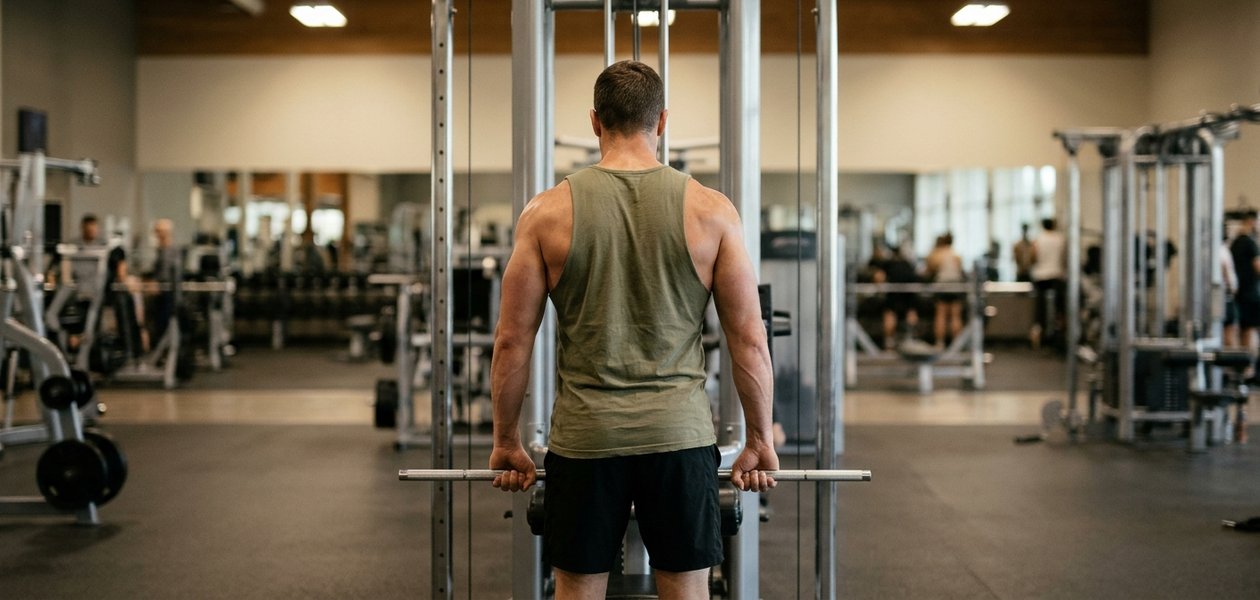
Coaches and strength writers agree on three payoffs from the straight-arm pulldown. Lifters who cannot feel their lats during rows learn where the muscle is, the lats get direct work for width without the biceps limiting the set, and the same tension that pins the arms down helps keep a deadlift bar close to the legs.
Sets, Reps and Where It Fits in a Back Workout
Coaching guides mostly program the straight-arm pulldown for 2 to 3 sets of 10 to 15 reps with a load that allows the pause at the bottom. The exercise fits in two places: a few light sets of 8 to 10 before deadlifts or pull-ups to wake up the lats, or a finisher at the end of back day.
Light weight suits the straight-arm pulldown. A 2021 review on loading found similar muscle growth across a wide range of loads, down to roughly 30% of a one-rep max. The CDC’s muscle-strengthening guideline asks adults to work every major muscle group, the back included, on 2 or more days a week.
How It Compares With the Seated Lat Pulldown
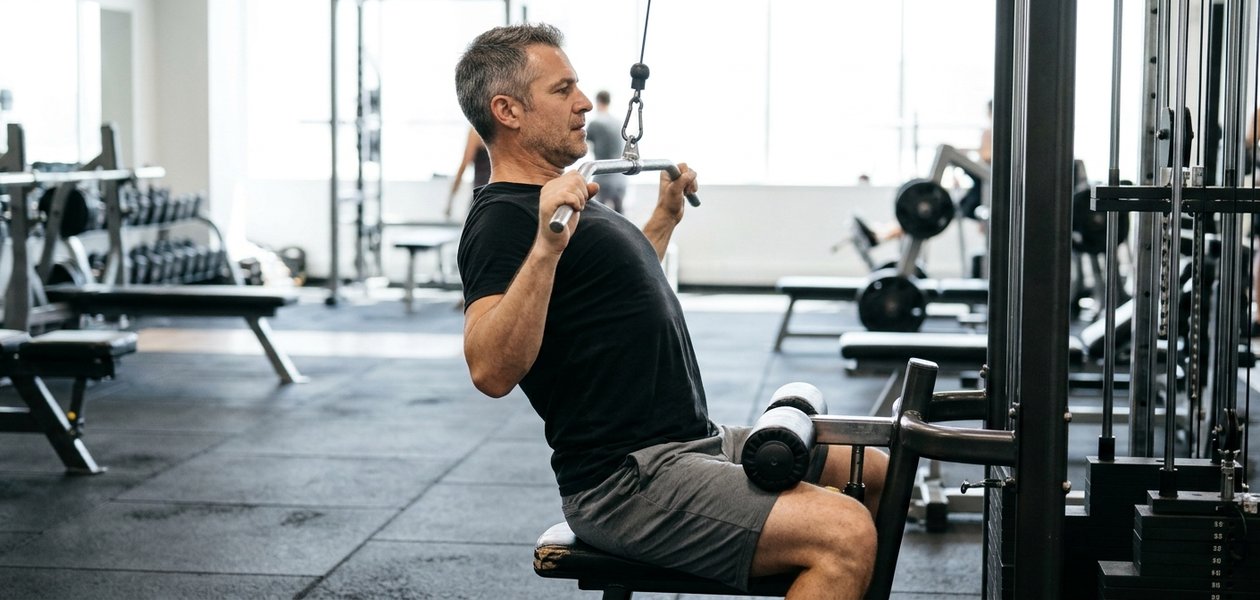
The straight-arm pulldown and the seated lat pulldown both train the lats with a cable, but they move different joints and suit different jobs in a program.
| Feature | Straight-arm pulldown | Seated lat pulldown |
|---|---|---|
| Body position | Standing, hips hinged forward | Seated, thighs under pads |
| Joints that move | Shoulder only | Shoulder and elbow |
| Main helpers | Teres major, long head of the triceps | Biceps, rear delts, upper back |
| Typical load | Light, controlled | Heavier, built up over time |
| Common role | Warm-up, finisher, lat isolation | Main vertical pull, pull-up builder |
Neither replaces the other: the straight-arm pulldown isolates the lats, while the seated lat pulldown builds pulling strength for chin-ups and pull-ups.
