
The lat pulldown was the first machine I ever felt confident on in a commercial gym, and years later it is still in my back routine every single week. It looks simple, you pull a bar down to your chest, but there is a surprising amount going on under the hood.
So what are the lat pulldown muscles worked? The short answer: the latissimus dorsi does most of the work, with the biceps, traps, rhomboids, rear delts, forearms, and even your abs assisting. Here is the full breakdown, plus the technique, grip variations, and programming I use to get the most out of every rep.
The Muscles a Lat Pulldown Works

The lat pulldown is a compound pulling exercise. When you pull the bar down, your shoulder moves through adduction (the upper arm sweeps down toward your side), your elbow flexes, and your shoulder blades rotate downward and pull together. The NASM breakdown of the lat pulldown maps each of those joint actions to the muscles driving them.
Because several joints are moving at once, a whole chain of muscles shares the load:
- Latissimus dorsi: the prime mover, and the largest muscle in your back
- Teres major: a small helper that works alongside the lats on every rep
- Biceps brachii: bends the elbow as you pull the bar down
- Trapezius (middle and lower fibers): controls your shoulder blades through the motion
- Rhomboids: squeeze the shoulder blades toward the spine
- Posterior deltoid: the rear shoulder assists the pull
- Pectoralis major: the chest pitches in on the downward drive of the arm
- Forearm and grip muscles: the brachialis, brachioradialis, and wrist flexors keep you attached to the bar
- Abdominals: brace your torso so the back muscles have a stable base to pull from
That list is why I treat the lat pulldown as a foundation movement, not an accessory. One machine trains nearly the entire upper back plus the arms in a single controlled motion.
What the lats actually do
The latissimus dorsi is a broad, fan-shaped muscle. It starts low, attaching along the lower spine, the back of the pelvis, and the lower ribs, then sweeps up and out to attach on the upper arm bone.
When it contracts, it pulls your arm down, back, and in toward your body, and it helps rotate the arm internally. Anatomy textbooks call that sweep toward the body shoulder adduction, and it is the signature motion the lats own.
You use your lats every time you pull a door open, swim a stroke, or lift yourself over something. Developed lats are also what create the V-shaped torso, wide at the top and tapering to the waist, which is the main aesthetic reason most men I know train them hard.
Is the lat pulldown a back or shoulder workout?
Train the back hard, then recover well with our workout recovery tips.
It is a back exercise. The confusion is understandable because the movement happens at the shoulder joint, and the rear delts do assist.
But the muscles producing the force, the lats, teres major, traps, and rhomboids, all live on your back. If your shoulders are burning out before your back on lat pulldowns, that is usually a technique problem, not a sign it is a shoulder movement.
Proper Lat Pulldown Technique
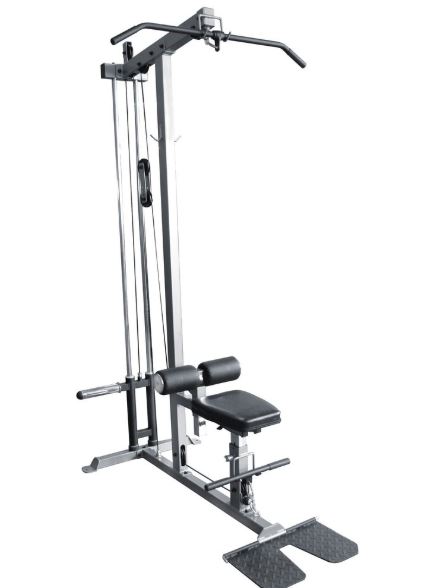
Proper technique decides which muscles actually do the work. Done right, the lat pulldown hammers the back. Done sloppily, it turns into a biceps and momentum exercise. This is the setup I run on any machine that works the latissimus dorsi, whether at my gym or in a hotel fitness room:
- Set the thigh pad snug against your legs so the weight cannot pull you off the seat
- Grab the bar with your hands just outside shoulder width, palms facing away
- Lean back slightly, about 20 to 30 degrees, keeping your spine neutral
- Pull the bar down to your upper chest by driving your elbows down and back toward your hips
- Hold the bottom for a one-second contraction and feel the shoulder blades pinch
- Control the bar back up until your elbows reach full extension and your lats stretch
That last step matters more than people think. The slow return is half the rep. Letting the stack yank the bar back up throws away the stretch portion of the lift, where a lot of the growth stimulus lives. I take two to three seconds on the way up, like lowering a heavy suitcase rather than dropping it.
Breathing has a rhythm too: exhale as you pull the bar down, inhale as you ride it back up. And before the working sets, I do one or two light warm-up sets just to groove the motion and wake up the connection between brain and back. Thirty seconds of preparation buys you much better lat activation on the sets that count.
Form mistakes that kill lat activation
The mistakes I see most often on this machine are the same ones I made for years. Leaning way back and rowing the weight with body English. Letting the head jut forward and craning the neck on heavy sets.
Shrugging the shoulders up instead of pulling them down. Cutting the range of motion in half by stopping the bar at the forehead and never reaching full extension at the top.
One variation deserves a specific warning: the behind-the-neck pulldown. NASM advises avoiding it, since it drags your head and neck into a forward posture and adds injury risk while delivering no extra lat activation compared to pulling to the front.
Pull to your chest, full range, with a weight you can handle honestly. If a set turns your neck or shoulder cranky, back off the load; I covered how I keep training around tweaks in my guide to staying active after an injury.
A strong back helps on the slopes too, as our guide to training for ski season shows.
Grip Variations and the Muscles They Emphasize

Here is the part most lifters get wrong: grip width changes the feel of lat pulldowns more than it changes the muscles. Research cited in NASM’s analysis found similar lat activation across narrow, medium, and wide grips. So the choice between a wide bar and a narrow handle is mostly about comfort, range of motion, and which assisting muscles share the work.
- Wide grip: the classic version, slightly more lat emphasis and less biceps, but a shorter range of motion
- Close or narrow grip: a longer range of motion and a bigger stretch at the top, with the biceps helping more
- Underhand (reverse) grip: palms facing you puts the biceps in a strong position and lets most lifters pull a little heavier
- Neutral grip: palms facing each other on a V-handle, usually the most comfortable option for the elbows and shoulders
- Single-arm pulldown: one handle at a time, the longest range of motion of the bunch and an honest contraction on each side, with no strong arm covering for the weak one
I rotate between an overhand grip just outside my shoulders and a neutral handle, week to week. The underhand lat pulldown is worth using too, especially if you struggle to feel your lats, because the stronger elbow position lets you focus on driving the elbows down instead of fighting your grip.
Is there a muscles worked percentage breakdown?
People like a clean chart that says the lats do 60 percent, the biceps 20, and so on. Honest answer: no trustworthy percentage breakdown exists, because muscle activation varies with grip, load, tempo, and the individual lifter, and EMG studies measure electrical activity rather than exact shares of the work.
What the research does support is the hierarchy. The latissimus dorsi shows the highest activation, the elbow flexors and scapular muscles work hard in support, and grip width shifts those supporting roles only modestly. Chase a strong contraction in the back on every rep and the percentages take care of themselves.
Lat Pulldown vs Pull-Up vs Seated Row

The lat pulldown and the pull-up are the same movement pattern, a vertical pull, which is why Healthline calls the pulldown an excellent substitute for pull-ups and chin-ups while you build the strength to do them. Interestingly, the research Healthline cites found the pulldown recruited the abdominals more than the pull-up did, so you are not just getting a watered-down copy.
Pair the strength work with our guide to losing stubborn weight for a leaner look.
That substitute role is personal for me. I could not do a single clean pull-up until I spent a few months progressing the pulldown: adding weight week by week, finishing every rep at full extension, and treating the negative like its own exercise. By the time I could pull down more than my body weight for reps, the first pull-up was simply there waiting.
The seated row is a different pattern, a horizontal pull. It hits many of the same muscles but shifts the emphasis toward the mid-back, the rhomboids and middle traps, rather than the lats. So lat pulldown vs seated row is the wrong question. They are partners, not rivals: one builds width, the other builds thickness, and a complete back program includes both.
Are lat pulldowns worth doing?
Absolutely. The pulldown lets you train the exact pulling motion of a pull-up at any strength level, scale the load in small jumps, and isolate your back without worrying about kipping or swinging.
Strong lats and a trained upper back also support better posture, since the same muscles that pull the bar down are the ones that hold your shoulders back at a desk. Swimmers, wrestlers, and climbers all rely on this same pulling pattern, which tells you how much it carries over to sport and daily fitness.
Sets, Reps, and Making Progress

For muscle growth I run the lat pulldown for 3 to 4 sets of 8 to 12 controlled reps, leaving a rep or two in the tank on each set.
For endurance work, lighter sets of 15 or more reps do the job. Add weight in the smallest jumps your stack allows, and only once every rep of every set is moving with proper form through the full range.
People ask which muscle is hardest to grow, and plenty of lifters would say the lats, mainly because they are hard to feel working. The fix is not more weight. It is slowing down, lightening the load, and thinking about pulling your elbows down rather than moving the bar. The mind-muscle connection on lat pulldowns improved for me the day I stopped chasing the stack.
And remember that your back grows between sessions, not during them. I leave at least 48 hours before training the same muscles again, and I treat sleep and food as part of the program; the full routine is in my guide to workout recovery.
So, what muscles do lat pulldowns work? Your lats first, backed by the teres major, traps, rhomboids, rear delts, biceps, forearms, and core. Pull to the chest with proper technique, use the grip that lets you feel your back, and progress patiently. I’ve never met a strong, well-built back that was not built on a steady diet of vertical pulls.


