

A stomach tattoo can stay under a shirt at work and still show at the beach or the gym. The ideas below, all common choices among men, are grouped by subject and style, then by placement, followed by what the area means for pain, body changes and healing.
Why the Stomach Is a Large, Symmetrical Canvas a Shirt Can Hide
The navel sits on the vertical center line of the torso, so a stomach tattoo built around it reads as balanced from the front. The abdominal muscles add natural divisions that an artist can follow, and the space between the ribs and the waistband takes a far bigger piece than a forearm can, all of it under a shirt.
Stomach skin also moves more than most. It folds when a man sits and stretches when he twists, so careful artists apply the stencil while the client stands naturally. The area is shaved for the session, and hair that grows back can soften fine linework, which favors bold outlines over delicate detail.
For most men the appeal is the way a stomach tattoo follows the body. A design that sits on the center line and tracks the abs and the lower edge of the chest looks deliberate, while one placed off center can drift as the torso bends and turns.
Animal Tattoo Designs Centered on the Navel and Abs
Animals are among the most popular subjects men pick for a tattoo on the stomach, because a head or a spread of wings fills the width of the torso without crowding it.
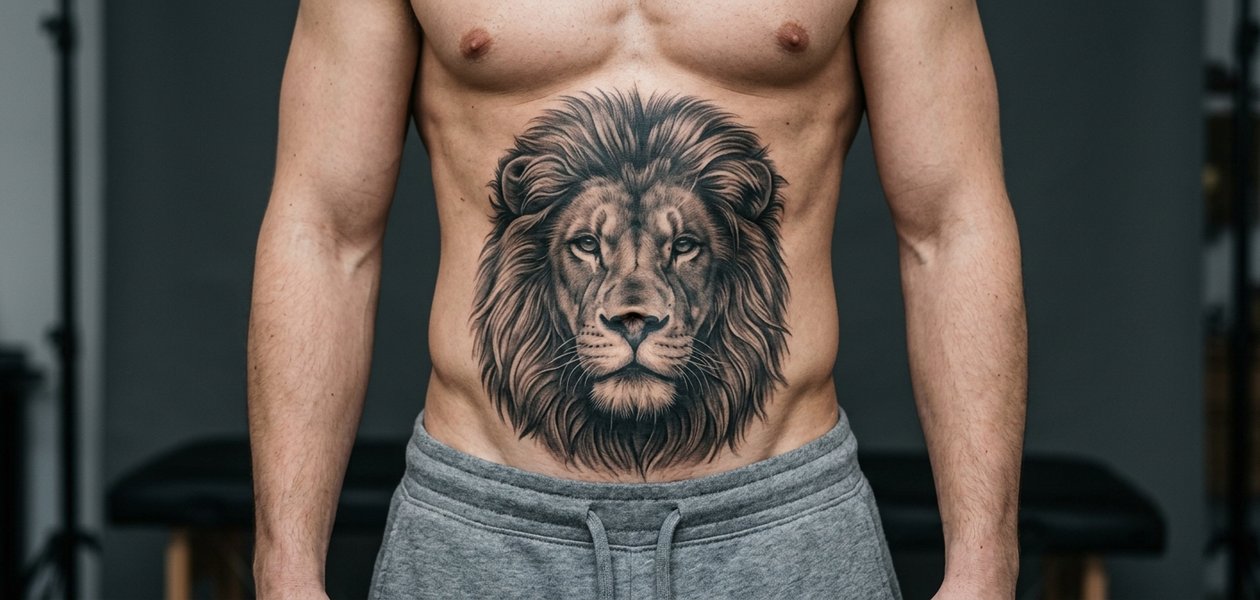
1. Lion head over the navel. A lion’s face tattooed over the belly button, with the mane spreading toward the ribs, turns the center of the stomach into the focal point. The lion stands for courage and leadership, and black and grey realism suits the shading of the mane.
2. Wolf. A wolf tattoo carries the idea of loyalty to a pack, which is why fathers, sons and brothers often choose it. A howling wolf works vertically along one side of the stomach, while a wolf’s face sits well in the middle.
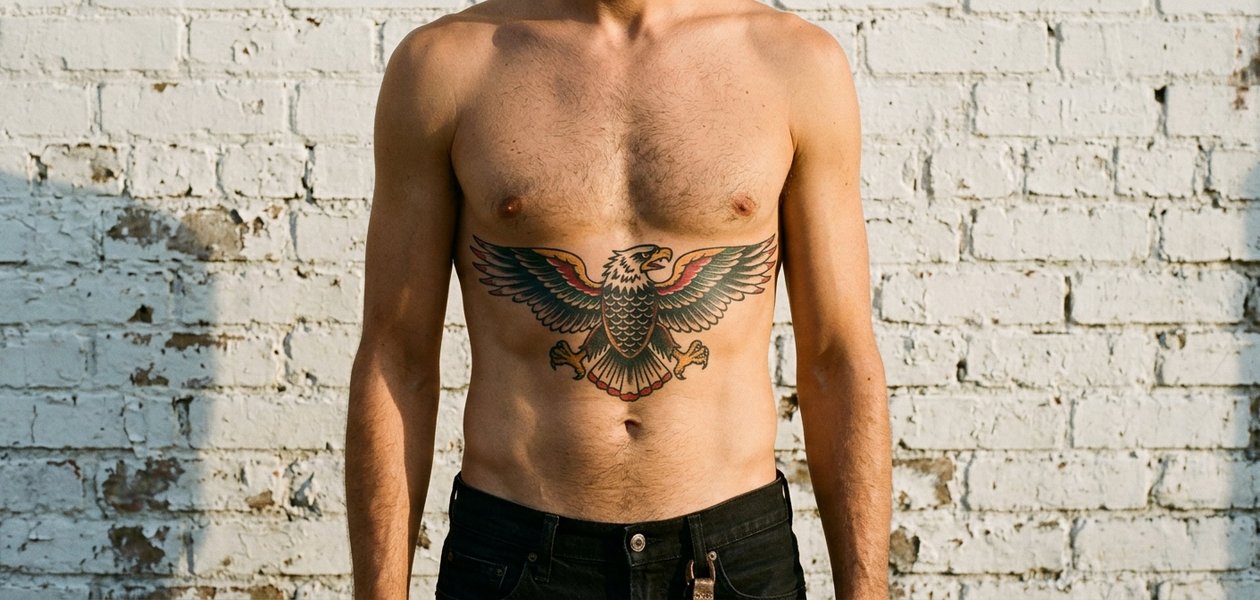
3. Eagle with spread wings. The spread eagle is a staple of American traditional stomach tattoos: the body sits on the upper abdomen and the wings reach toward each side. Bold black outlines and a small palette of red, yellow and green keep it readable for decades.
4. Prowling tiger. A crouching or prowling tiger tattoo can run diagonally across the stomach from the ribs toward the hip, using the full length of the torso. In Japanese tattooing the tiger stands for strength and protection, and it is often drawn with bamboo.
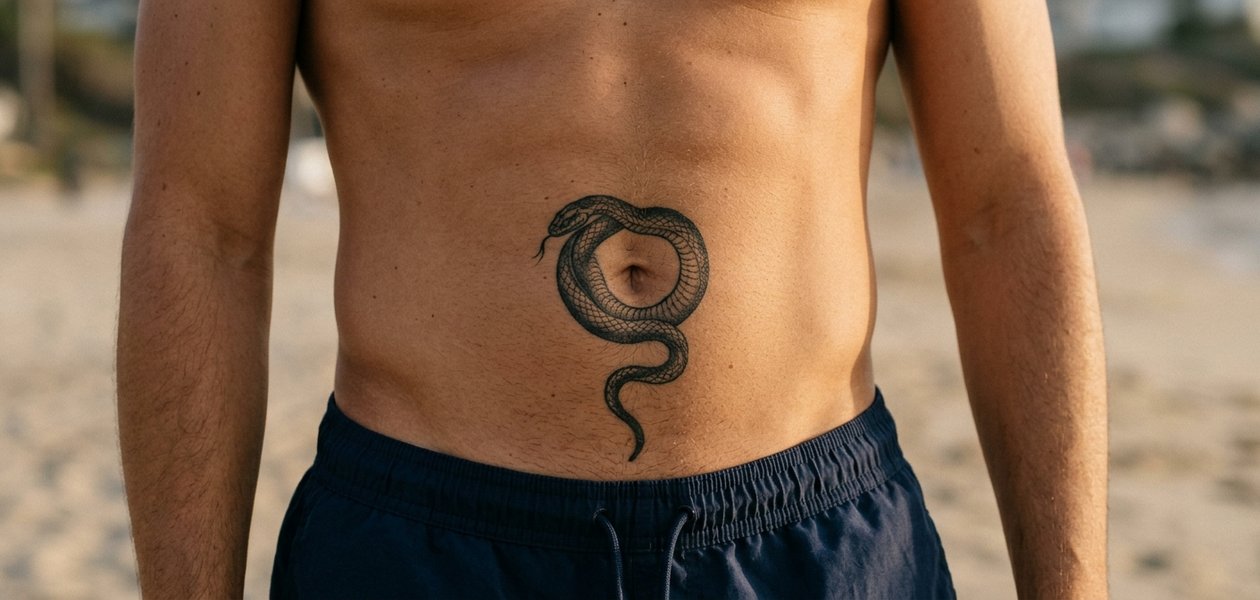
5. Snake coiled around the belly button. A snake tattoo wrapped around the navel is one of the few stomach designs that makes the navel part of the image. Its body can trail toward the hip or climb toward the chest, so the coil adapts to almost any build.
6. Bear. A bear’s head or a standing bear tattooed on the stomach suits a broad midsection and reads as raw strength and protection. Woodcut or blackwork styles give the fur texture without fine detail that could blur.
7. Owl with open wings. An owl tattoo with outstretched wings mirrors the symmetry of the stomach, and its round face can sit right over the navel. It is a common symbol of wisdom and watchfulness.
Japanese, Polynesian and Traditional Styles for a Large Piece
Traditional styles were built for large areas of skin, which is why they move so well onto the front of the torso.
Japanese stomach tattoos borrow from a tradition in which a typical full body suit covers the arms, back, upper legs and chest, and the Pitt Rivers Museum’s account of Japanese irezumi notes it can take up to 5 years of weekly visits and cost more than £15,000.
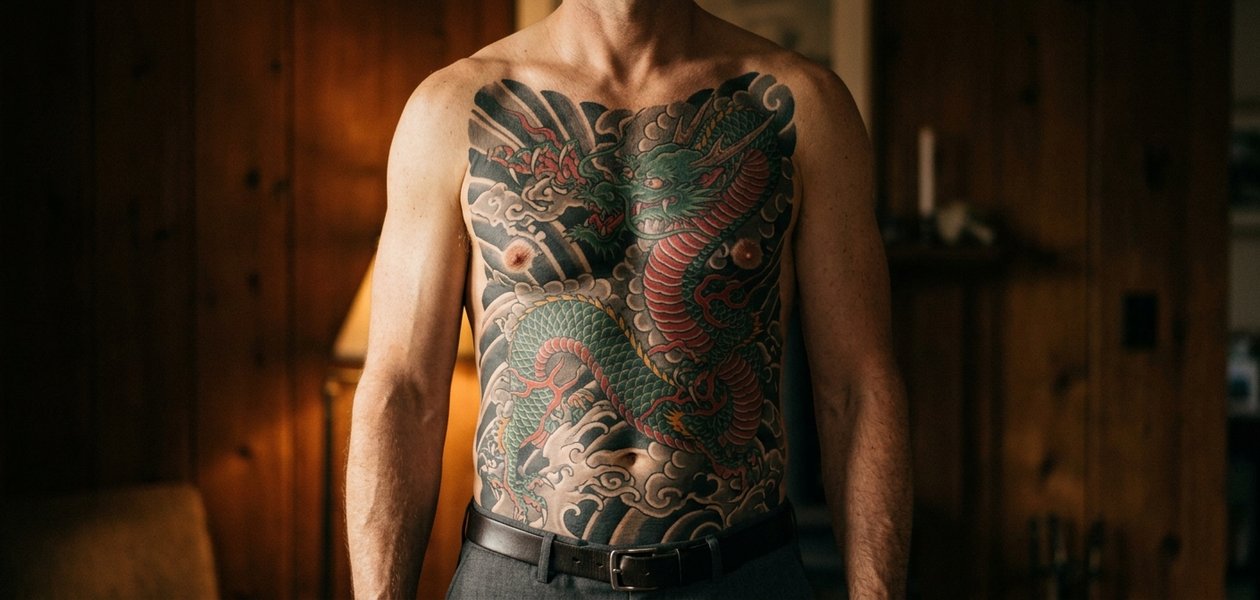
8. Japanese dragon. A dragon tattoo can coil from the chest across the stomach, with clouds or waves filling the space between its loops. It is the classic choice for a man who plans to extend the work onto the chest or ribs later.
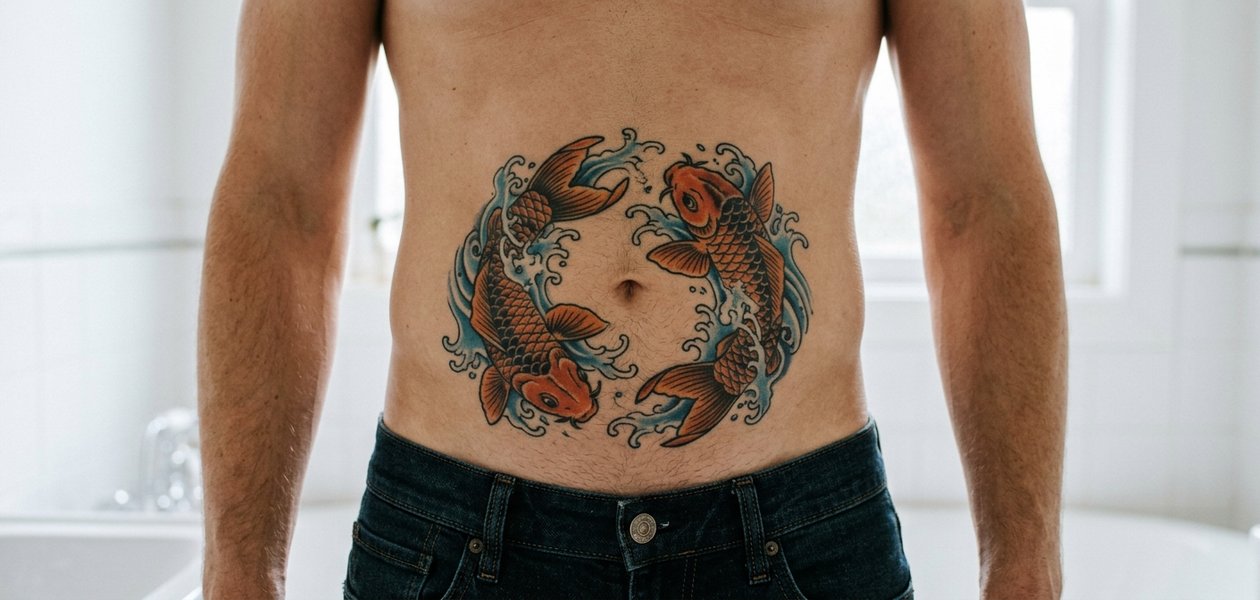
9. Koi fish. A koi tattoo swimming upstream, a symbol of perseverance in Japanese art, curves naturally across the stomach. Two koi circling the navel in opposite directions make a balanced composition.
10. Hannya mask. The hannya, a horned demon mask from Noh theater, gives a stomach tattoo a dramatic centerpiece below the chest. Its wide, symmetrical shape matches the width of the upper abdomen.
11. Polynesian linework. The Samoan pe’a spans from the waist to the knee, according to the National Park Service guide to Samoan tatau. The Pitt Rivers Museum describes its symmetrical designs of bands, lozenges, dots and triangles.
Men outside that culture who want the look can ask for Polynesian inspired tattoo bands across the lower stomach, ideally from an artist who knows what each motif means.
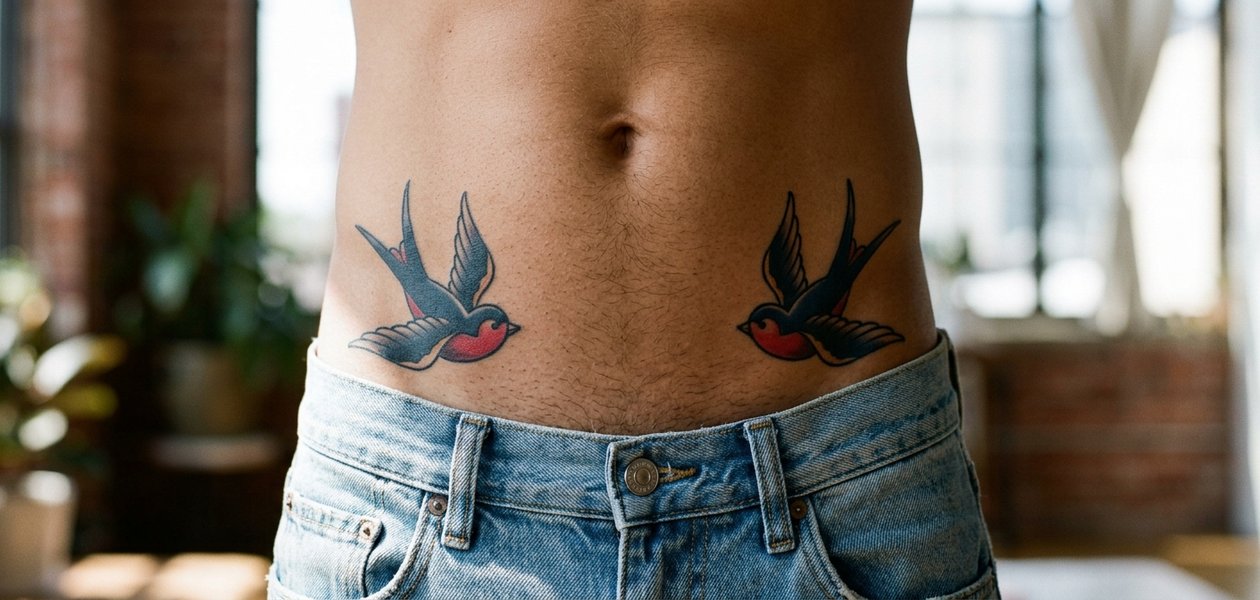
12. Pair of swallows. Two swallow tattoos, one on each side of the lower stomach, are a sailor’s design tied to returning home. The mirrored birds frame the navel and scale up or down easily.
13. Ship or anchor. A full rigged ship or an anchor tattoo wrapped in rope suits the vertical space between the breastbone and the navel. American traditional versions use thick lines and solid color that hold up as skin ages.
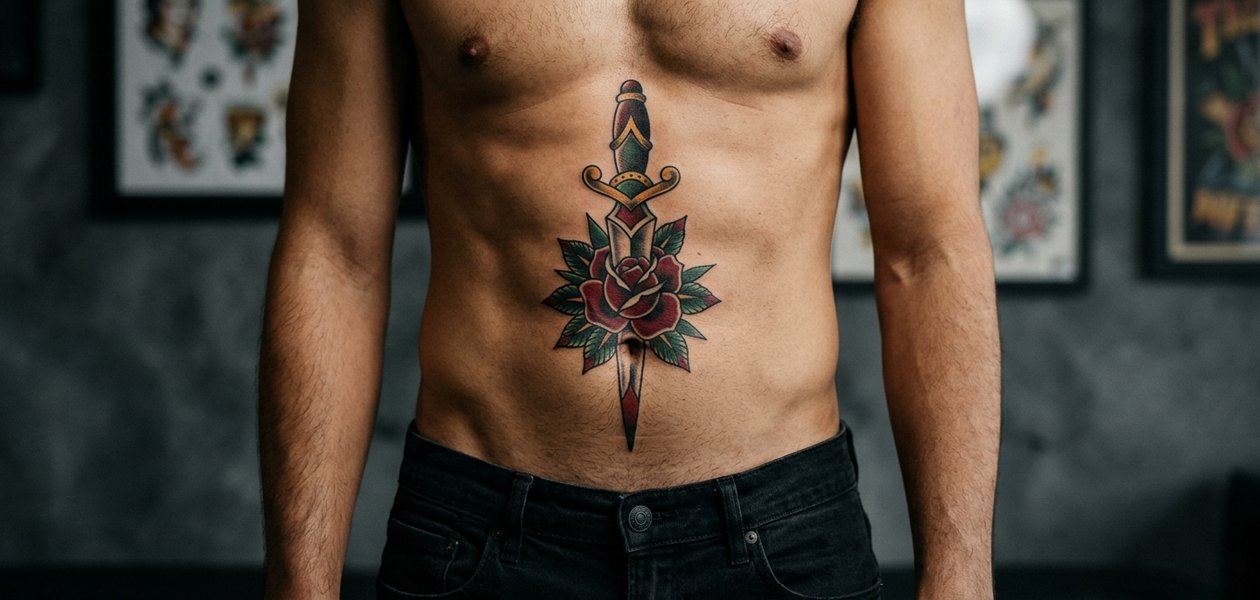
14. Dagger through a rose. A dagger piercing a rose sets a hard edge against a soft shape, and tattooed vertically on the stomach it follows the line down the middle of the abs. It is a flash classic that most traditional artists know by heart.
Skulls, Wings, Crosses and Other Symbolic Pieces
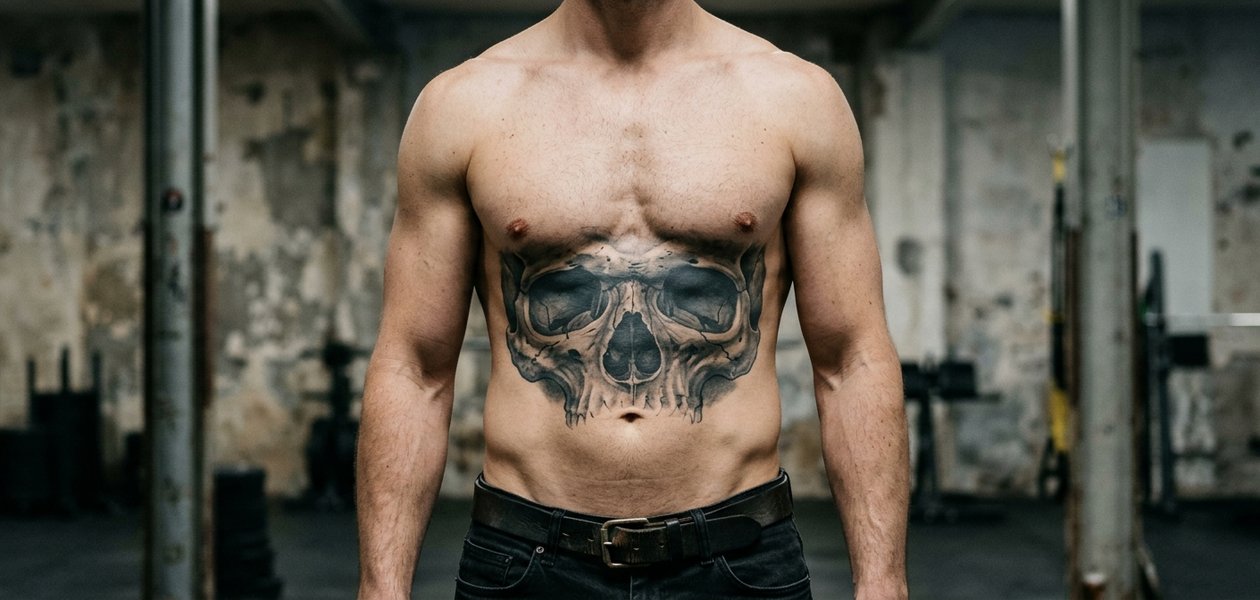
15. Skull. A large skull tattoo across the upper stomach, its hollow eyes level with the bottom of the chest, is one of the boldest options and a reminder of mortality. Black and grey shading suits it best.
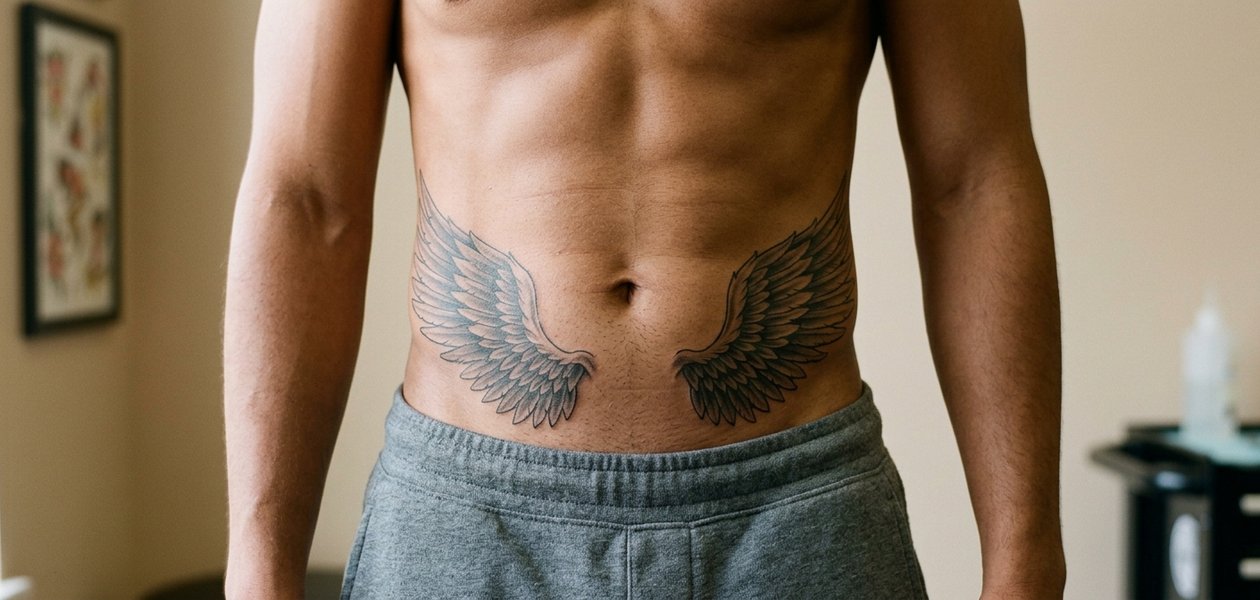
16. Wings toward the hips. A pair of tattooed wings spreading from the center line toward each hip frames the lower stomach and flatters a lean or muscular man. A small skull, heart or emblem at the center gives the eye a focal point.
17. Grim reaper. A hooded reaper tattoo with a scythe fills a tall space on the stomach from the sternum toward the navel. It pairs well with an hourglass, a common symbol of limited time.
18. Cross. A cross tattoo, plain or surrounded by rays of light, sits naturally on the center line of the stomach. Religious men often extend it into a larger scene with clouds or praying hands.
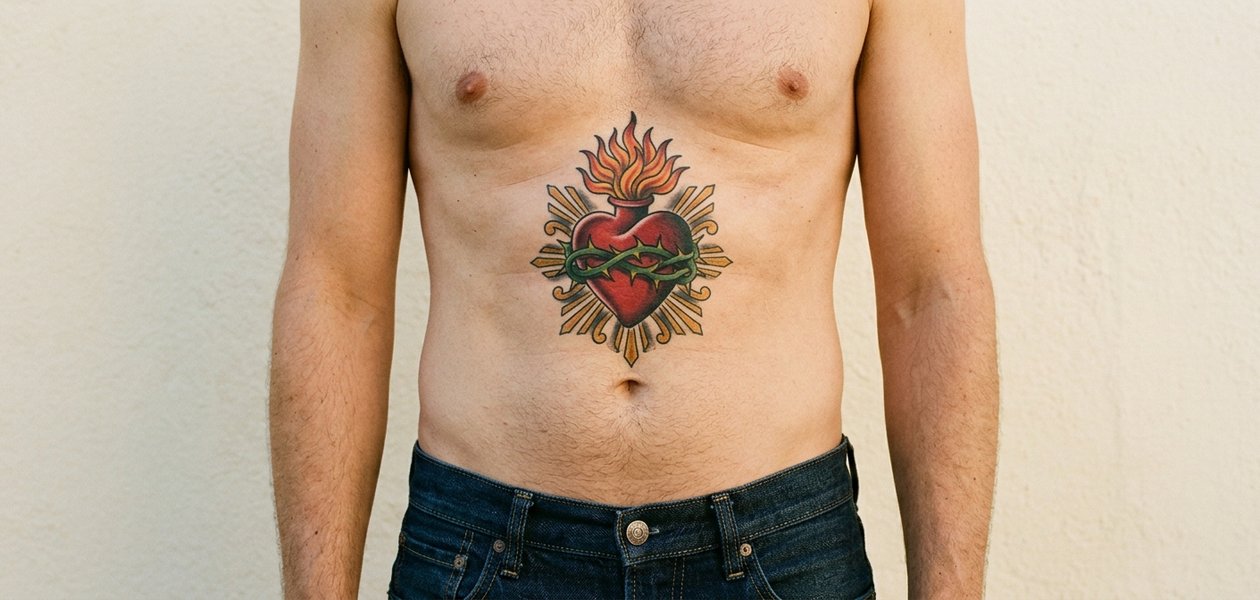
19. Sacred heart. The sacred heart, a flaming heart wrapped in thorns from Catholic devotion, fits the upper stomach just below the breastbone. Its traditional red and gold palette gives the piece strong contrast.
20. Phoenix. A phoenix tattoo rising with open wings stands for rebirth and suits a man marking a recovery or a fresh start. The tail feathers can sweep down toward one hip.
Mandala, Geometric and Blackwork Tattoos That Use Symmetry
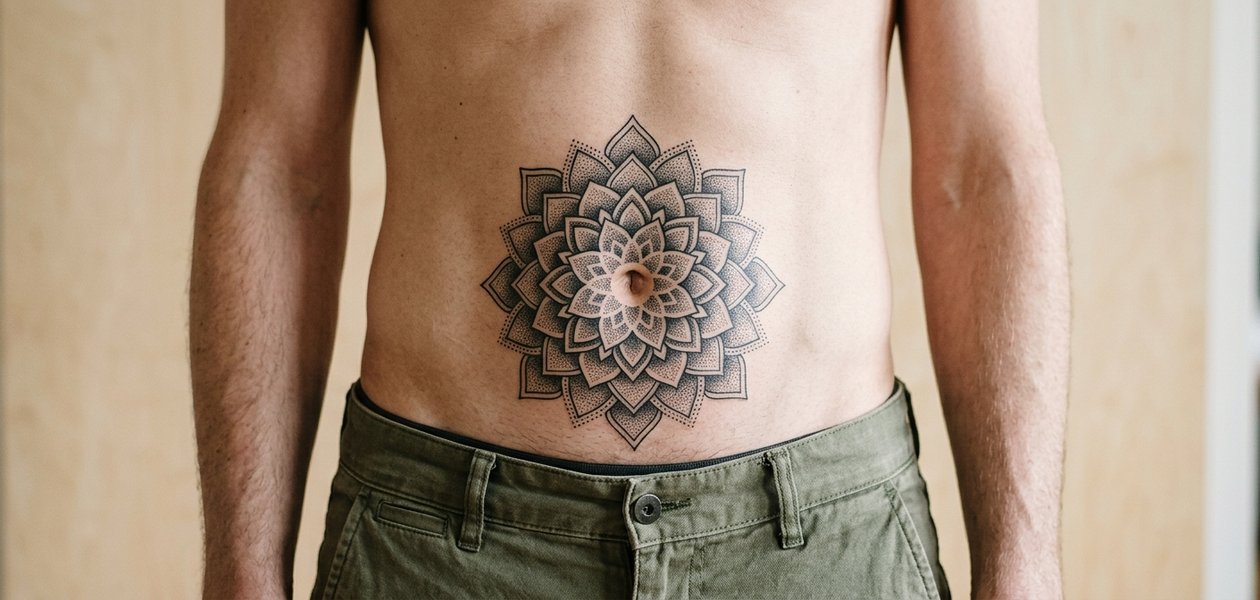
21. Mandala around the navel. A mandala tattoo with the belly button at its center is the clearest way to use the symmetry of the stomach. Its circular layers of petals and dots expand outward and can be extended later.
22. Sacred geometry. Sacred geometry tattoos of nested triangles, circles and the Flower of Life pattern give the stomach a clean, modern look. Straight lines are hard to keep straight on curved, moving skin, so this style rewards a geometric specialist.
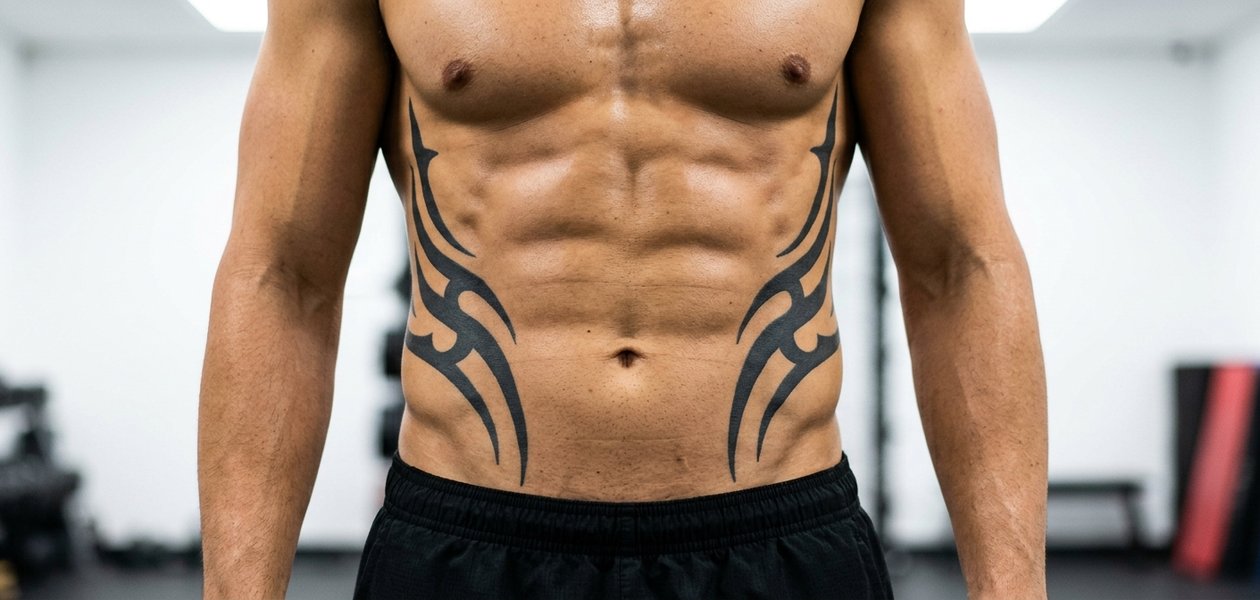
23. Tribal shapes along the muscles. Bold black tribal tattoo shapes can trace the edges of the stomach muscles, framing them rather than covering them. The heavy black areas stay legible even as fine detail softens.
24. Biomechanical. A biomechanical stomach tattoo shows gears, pistons and torn skin as if a machine sat underneath. The ridges of the abs give the illusion extra depth.
25. Ornamental blackwork. Ornamental blackwork tattoos, built from lace, filigree and solid black panels, can run from the chest down over the stomach as one continuous piece.
Placement Options: Lower Belly, Sides, Upper Abdomen and Chest
Where a stomach tattoo sits matters as much as what it shows. Each part of the stomach favors a different shape:
| Placement on the stomach | Shape it suits | Tattoo designs that fit |
|---|---|---|
| Full stomach | Wide and centered | Lion head, mandala, dragon, skull |
| Upper stomach | A wide band under the chest | Eagle, sacred heart, hannya mask |
| Lower stomach and waistline | A horizontal band or a V toward the hips | Wings, swallows, a single word |
| Side of the stomach | Tall and narrow | Snake, koi, a line of script |
| Around the belly button | A circle | Mandala, coiled snake, sun |
| Chest to stomach | Tall and wide | Dragon, ship, religious scene |
26. One word across the lower stomach. A single word or short phrase tattooed in bold script across the lower belly, from a family name to a personal motto, is a long standing classic. Large, widely spaced letters age better than small, tight script.
27. Side stomach piece along the obliques. The side of the stomach takes tall tattoo designs such as a snake, a koi or a vertical line of script from the ribs to the hip. It is easier to hide than a centered piece and can later join a rib piece.
28. Upper stomach band under the chest. A tattoo across the upper stomach, directly under the chest muscles, can stand alone or start a larger chest panel. It is the section closest to the sternum, so it is also among the more painful.
29. Chest to stomach panel. One tattoo composition from the collarbones to the waistband, such as a religious scene or a dragon, is the largest option on the front of the body. It is built over several sittings.
30. Vines along the waistline. Vine tattoos with leaves or a few roses following the waistband from one hip to the other read as subtle and suit a man who wants something mostly hidden.
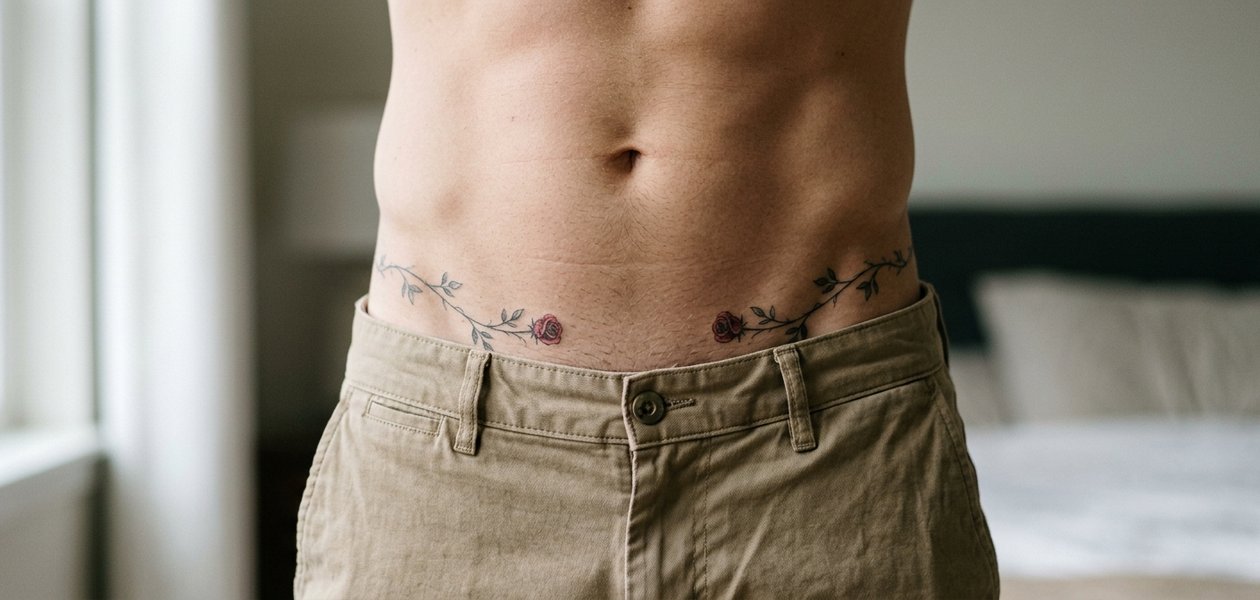
31. Small stomach symbol near the hip. A compass, an anchor, a date in Roman numerals or a set of initials at the edge of the stomach is a low commitment first tattoo for guys new to ink. It can grow into a larger design later.
How Much a Stomach Tattoo Hurts, Upper Versus Lower
Pain from a stomach tattoo is real but manageable for most people. In a study of pain during and after tattooing that surveyed 1,092 tattooed adults in Poland, the average pain during the session was 4.35 on a scale of 0 to 10, and the men in it averaged 4.48. That figure covers all body areas, not the stomach alone.
The same study found that men’s sessions tended to run longer and that their pain built with every passing hour. On the stomach, the upper section near the sternum and lower ribs has thin skin over bone and usually hurts more, while the softer lower belly feels closer to a sting or a burn.
Price follows size and hours. Most artists charge by the hour or by the finished piece, so a small symbol near the hip costs a fraction of a full stomach tattoo, which is split over several sittings and can take months to finish.
What Weight Gain, Weight Loss and Muscle Growth Do to a Stomach Tattoo
Midsection skin changes size with weight more than most skin does. The American Academy of Dermatology lists rapid weight loss or gain, and weight training that brings rapid muscle growth, among the times stretch marks are most likely to appear. A stomach tattoo over that skin stretches with it, and lines crossed by stretch marks can look broken.
A slow, modest change is less likely to distort a piece than a fast swing. Men planning a big weight loss or a bulking phase often wait until their weight settles, and bold outlines with open spacing tolerate change better than fine detail and tight lettering.
Healing a Stomach Tattoo Under a Waistband
Clothing is a particular problem while a stomach tattoo heals, because waistbands and belts rub right across the fresh work. Cleveland Clinic’s aftercare advice is to wash the area gently twice a day, keep it moisturized and wear loose, breathable clothing over a covered tattoo.
Itching, flaking and some scabbing are normal in the first 2 to 4 weeks of a new tattoo. The top layer of skin is usually healed by about 2 months, the deeper layers can take several months more, and large pieces heal more slowly than small ones on the hands or wrists.
- Loose waistbands: loose or low trousers, and no belt pressing on the new ink while it heals.
- The right moisturizer: the artist’s aftercare product during the first days, then a water-based lotion for dry tattooed skin, which dermatologists advise over petroleum jelly, since petroleum-based products can fade the ink.
- Sunscreen once healed: a broad-spectrum, water-resistant sunscreen of SPF 30 or more keeps the colors of a stomach tattoo from fading at the pool or the beach.
The same dermatology advice favors skin free of moles for new ink, because a tattoo can hide early signs of skin cancer, and calls for a board-certified dermatologist if the skin reacts or changes. The FDA lists infections, allergic reactions, granulomas and keloids among the risks of any tattoo.
For the meaning behind the most popular designs in other spots on the body, a broader set of men’s designs and what they symbolize covers animals, sailor flash, faith symbols and more.
