
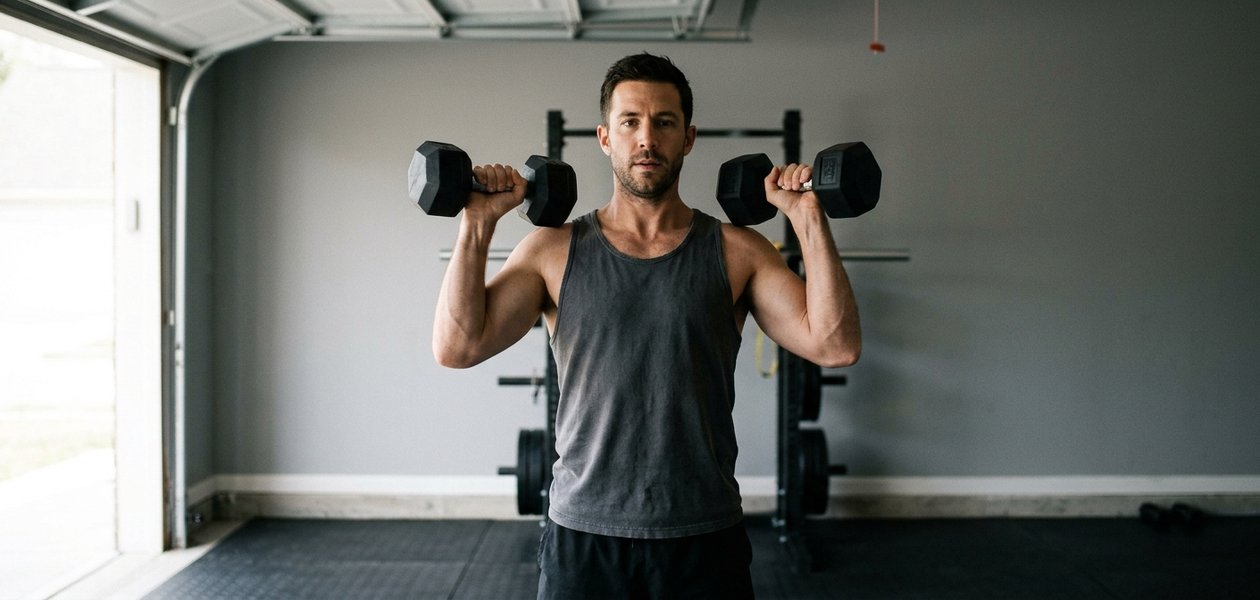
The six dumbbell shoulder exercises below are the overhead press, Arnold press, lateral raise, front raise, bent-over rear delt fly and side-lying external rotation. After them come a sample session with sets, reps and rest, how heavy each dumbbell should be, how often to train the shoulders, and the form faults that steal work from the delts.
Which Shoulder Muscles Dumbbell Exercises Train
The deltoid is the rounded muscle that caps the shoulder. Anatomists split it into three sets of fibers, a front (clavicular) part, a middle (acromial) part and a rear (spinal) part, as the deltoid muscle entry describes. Each head pulls the arm in a different direction, so no single dumbbell exercise loads all three equally.
- Front delt: lifts the arm forward and across the body, and it helps on every press, the bench press included.
- Side delt: raises the arm out to the side and gives the shoulders their width when seen from the front.
- Rear delt: pulls the arm back and out, balancing the front of the joint.
- Rotator cuff: four smaller muscles under the deltoid (supraspinatus, infraspinatus, teres minor and subscapularis) that keep the ball of the upper arm in its socket.
Lab data shows how the heads share the work. In a 2020 study of 13 trained men published in the Journal of Human Kinetics, the shoulder press produced the highest front delt activity of four exercises, 33.3% of maximal activation.
The lateral raise led for the side delt at 30.3% and for the rear delt at 24%, while the bench press and the dumbbell fly stayed at 5% or less on the side and rear heads.
That split is the reason a good shoulder workout pairs a press with raises. The press also worked the side delt almost as hard as the lateral raise did (27.9% against 30.3%), but it gave the rear delt only 11.4%, so the back of the shoulder needs its own direct work.
Six Dumbbell Exercises for the Front, Side and Rear Delts
The order below is the one most coaches program: the heaviest press first, then raises for the side and front delts, then light work for the rear delt and rotator cuff. Each move names the shoulder head it loads most, so the list doubles as a menu for shorter workouts.
Presses for the Front and Side Delts
1. Dumbbell Overhead Press. This is the main strength lift of the workout. Pressing a pair of dumbbells from shoulder height to straight arms works the front delts hardest, with the side delts and triceps helping.
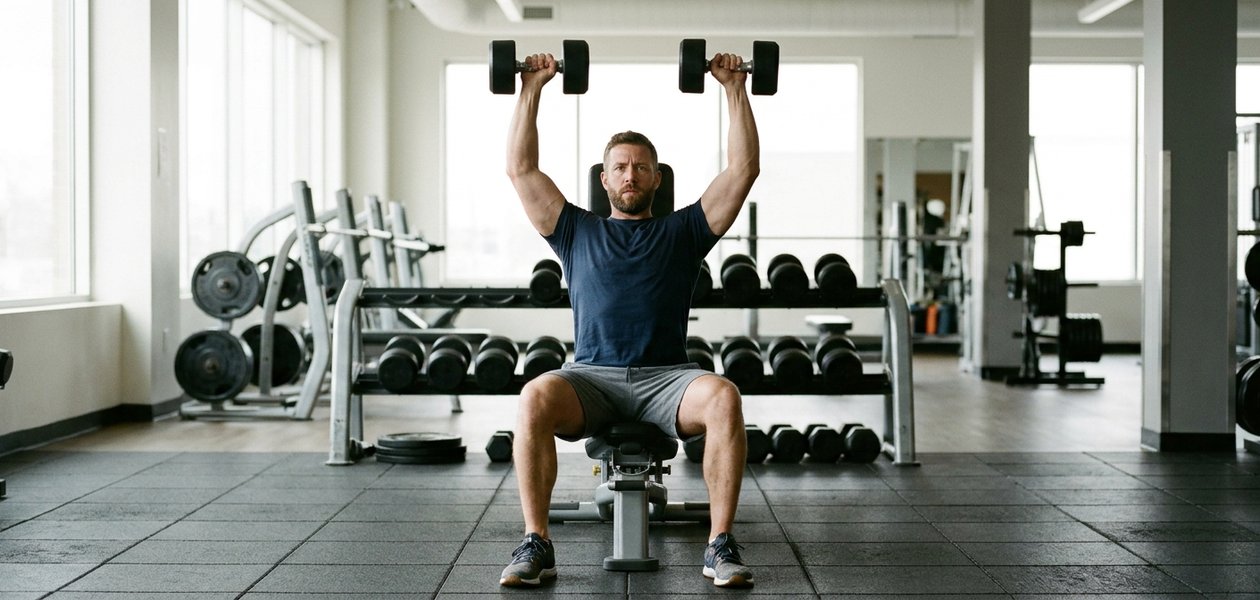
The overhead press entry notes that the lift can be done seated or standing, and that standing recruits more muscles because the lifter must balance the load.
- Start: dumbbells at shoulder height, palms forward or angled slightly in, elbows a little in front of the body rather than flared straight out.
- Brace: tighten the glutes and abs so the lower back stays neutral instead of arching.
- Press: drive the weights up until the arms are straight and the dumbbells sit over the shoulders.
- Lower: bring them back to ear level under control, taking about two seconds.
A bench with a back pad usually lets a lifter handle heavier dumbbells, while standing asks more of the trunk. Both build the shoulders, so the choice comes down to goals and how the lower back feels.
2. Arnold Press. This press adds a rotation. The dumbbells start in front of the face with the palms turned toward the lifter, and the hands rotate outward as they rise until the palms face forward at the top.
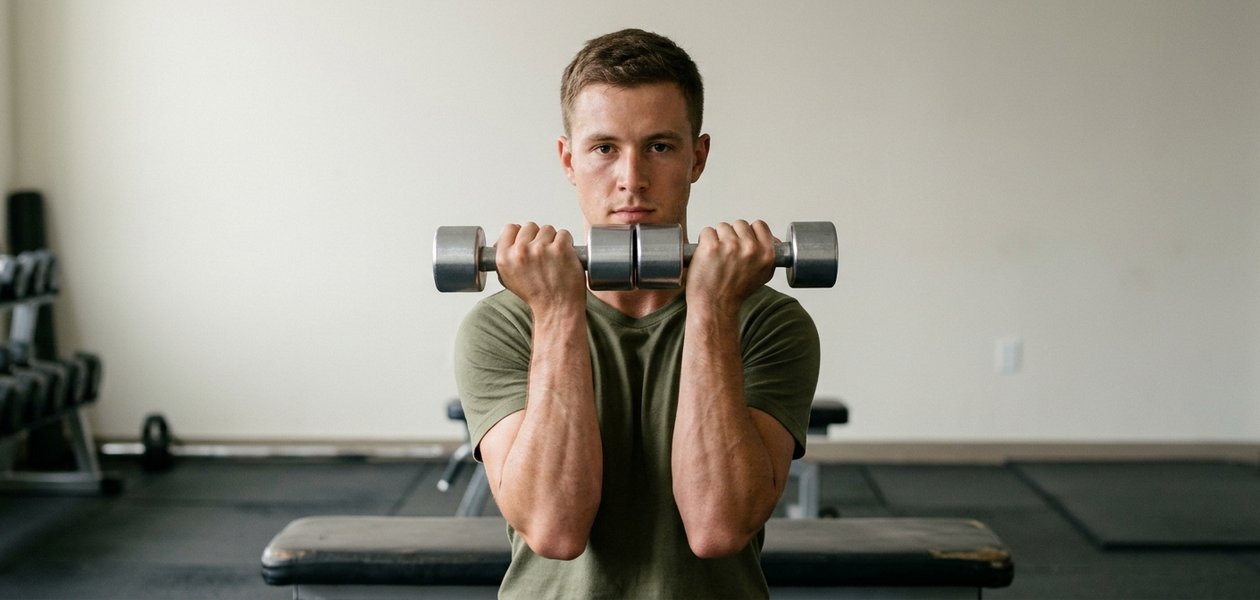
Because the elbows travel from the front of the body to the sides, the shoulder moves through more of its range than in a plain press, so most men use lighter dumbbells for it.
- Set up: sit tall with the dumbbells at chin height, palms facing the face and elbows in front.
- Rotate and press: spread the elbows and turn the palms outward while pushing the weights up.
- Finish: arms straight overhead, palms facing forward, ribs down.
- Return: reverse the turn on the way down so the palms face the body again at the bottom.
Raises for the Side and Front Delts
3. Lateral Raise. This is the most direct dumbbell move for the side delt. In a 2020 study of 10 competitive bodybuilders in the International Journal of Environmental Research and Public Health, raises to 90 degrees with the thumbs pointing forward produced more side delt activity than a thumbs-up raise or a bent-elbow version.
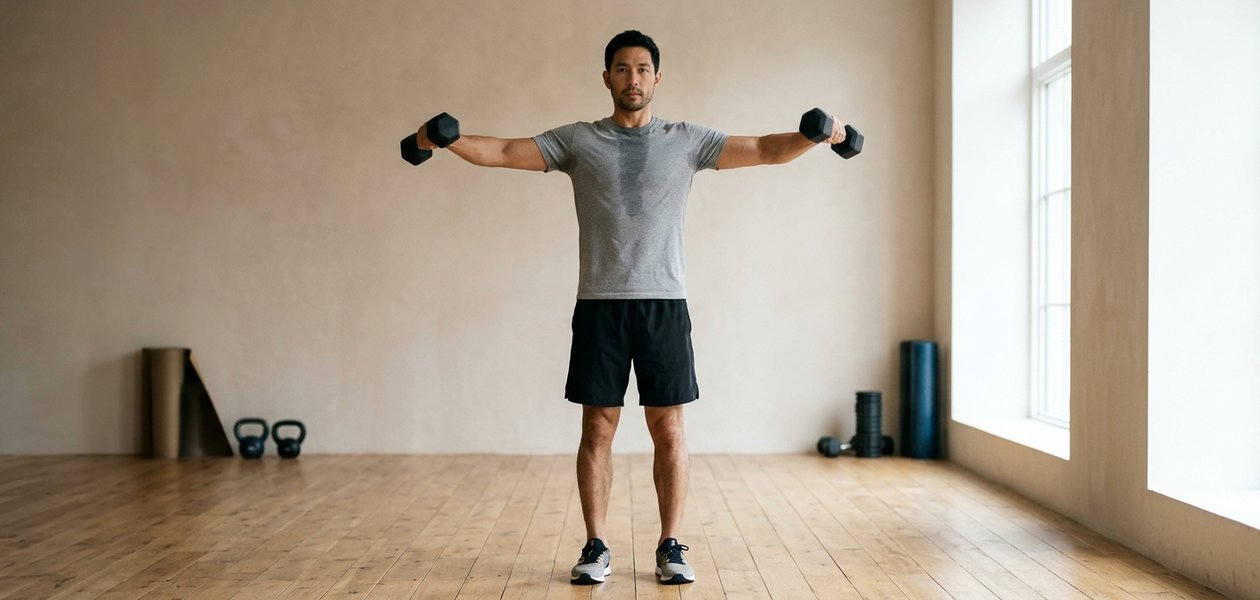
Turning the thumbs down raised activity in the rear delt, the upper trapezius and the triceps.
- Grip: light dumbbells at the sides, a soft bend in the elbows, thumbs pointing forward.
- Lift: raise the arms out to the sides until they reach shoulder height, about 90 degrees.
- Shoulders down: keep them away from the ears so the traps do not take over.
- Lower: slowly, without letting the dumbbells bounce off the thighs.
4. Front Raise. This isolation move targets the front delt. The same bodybuilder study found that the frontal raise mainly worked the front delt and the chest’s pectoralis major. Since every press already loads the front of the shoulder, many programs keep front raises to two light sets, or use them when pressing is uncomfortable.
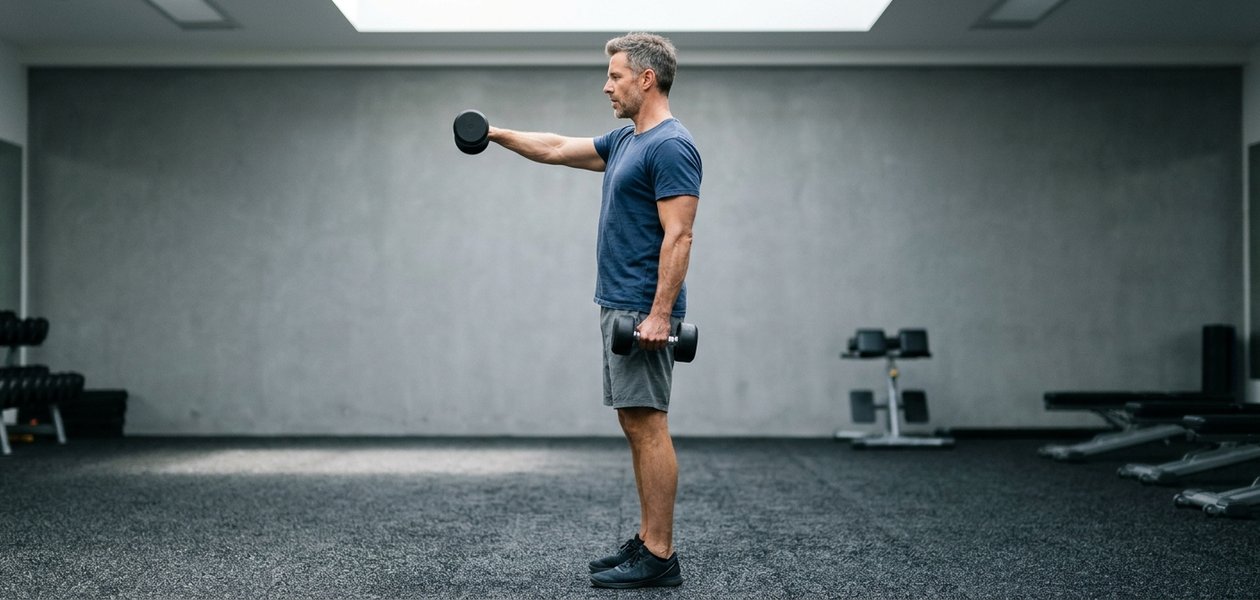
- Grip: dumbbells in front of the thighs, palms facing the body or each other.
- Lift: raise one or both arms forward to shoulder height with the elbows nearly straight.
- Stay still: the torso does not lean back, since leaning turns the raise into a swing.
- Alternate if needed: one arm at a time makes it easier to keep the trunk quiet.
Rear Delt and Rotator Cuff Work
5. Bent-Over Rear Delt Fly. The rear delt is small and often lags, because presses and chest work keep loading the front of the shoulder. Hinging forward and sweeping light dumbbells out to the sides trains the back of the shoulder and the upper back.
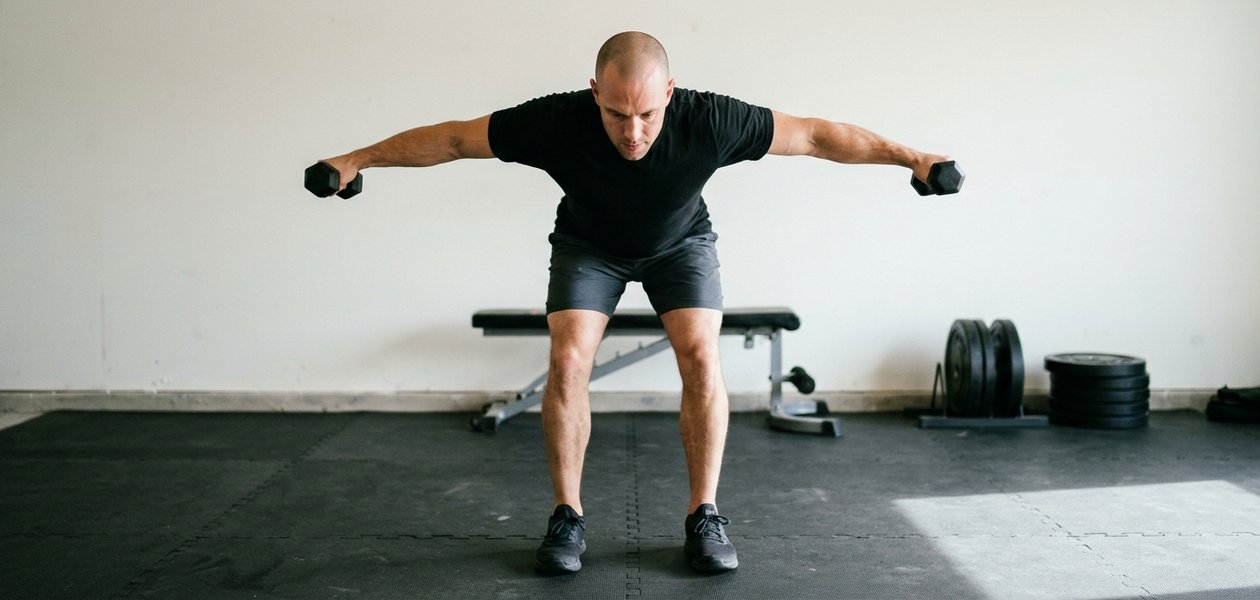
A chest-supported version, lying face down on an incline bench, takes the lower back out of the lift.
- Hinge: bend at the hips until the torso is close to parallel with the floor, back flat and knees soft.
- Hang: dumbbells under the chest, palms facing each other, a slight bend in the elbows.
- Sweep: lift the arms out wide until they line up with the torso, leading with the elbows.
- Easy squeeze: pinching the shoulder blades hard at the top lets the upper back take over, so keep the motion at the shoulder.
6. Side-Lying External Rotation. This small move trains the rotator cuff. The shoulder conditioning program from the American Academy of Orthopaedic Surgeons lists it for the infraspinatus, teres minor and rear delt.
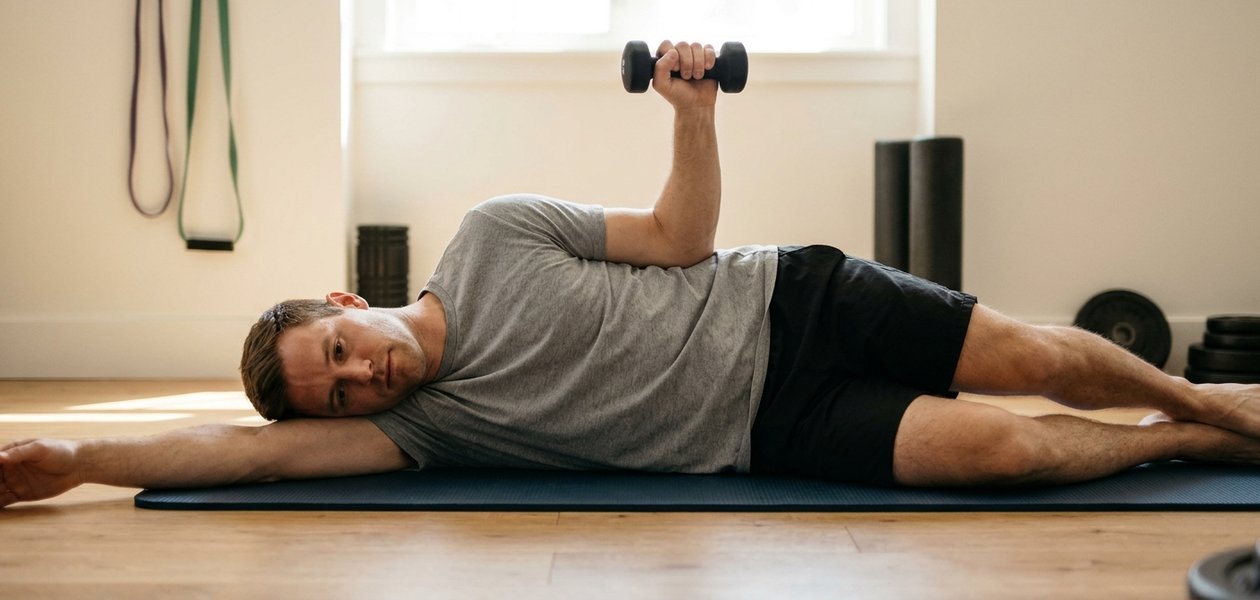
The program starts with about 1 to 2 pounds for 2 sets of 8 to 10 reps and adds weight in 1 pound steps up to a top weight of 5 to 10 pounds.
- Position: lie on one side with the top elbow bent to 90 degrees and pinned against the ribs.
- Rotate: turn the forearm up toward the ceiling while the elbow stays on the side.
- Lower: slowly, to a count of five, without letting the body roll back.
A Sample Shoulder Workout With Sets, Reps and Rest
The table turns the six moves into one complete shoulder workout. Presses sit in the lower rep range because they take the heaviest dumbbells; raises and rotator cuff work use lighter weights for more reps.
| Exercise | Main target | Sets | Reps | Rest |
|---|---|---|---|---|
| Dumbbell overhead press | Front delt | 3 | 8 to 12 | 90 seconds |
| Arnold press | Front and side delt | 2 | 10 to 12 | 60 to 90 seconds |
| Lateral raise | Side delt | 3 | 12 to 15 | 60 seconds |
| Front raise | Front delt | 2 | 10 to 12 | 60 seconds |
| Bent-over rear delt fly | Rear delt | 3 | 12 to 15 | 60 seconds |
| Side-lying external rotation | Rotator cuff | 2 | 8 to 10 per arm | 60 seconds |
Run the workout in this order:
- Warm up: 5 to 10 minutes of easy activity such as walking or a stationary bike, the warm-up the AAOS program uses before its shoulder exercises.
- Ramp the press: one or two light sets of the overhead press before the first work set.
- Work sets: end each set one or two reps short of failure with clean form.
- Finish small: close with the rear delt fly and the external rotation, which need the least weight.
- Progress: once every set reaches the top of its rep range, move up to the next pair of dumbbells.
Shrugs and upright rows are optional extras. Shrugs train the upper trapezius rather than the deltoids, so they belong in the plan only when bigger traps are a goal.
How Heavy the Dumbbells Should Be for Each Exercise
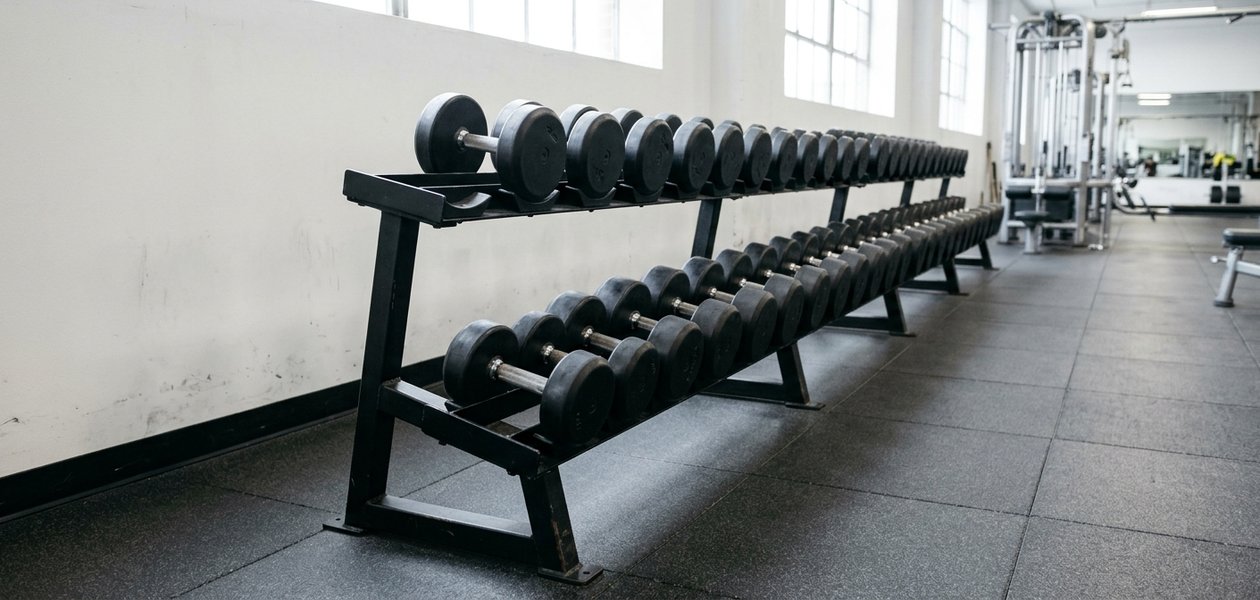
No chart can name the right weight for every man, but the moves fall into three load groups. Presses take the heaviest pair, raises a much lighter one, and rear delt and rotator cuff work the lightest of all.
- Presses: a pair that allows 8 to 12 clean reps, with the last two reps hard.
- Side and front raises: usually far lighter than the press, because the straight arm acts as a long lever.
- Rear delt flyes and external rotation: the lightest dumbbells in the rack; the AAOS program starts its rotator cuff moves at 1 to 2 pounds.
Dumbbell jumps are the catch. Many gym racks rise in 5 pound steps, so going from 15 to 20 pound dumbbells adds 10 pounds to the pair, a one-third jump on a lateral raise. Adding reps first and weight second keeps raises strict.
Light dumbbells still build muscle. A 2022 umbrella review of 14 meta-analyses in Frontiers in Sports and Active Living found that light and heavy loads both work when sets end at or close to failure, though heavier loads seemed to give somewhat bigger gains.
How Often to Train Shoulders Each Week
The CDC’s adult activity guidelines call for muscle-strengthening activities on 2 or more days a week that work all major muscle groups, the shoulders included. For size, the umbrella review recommends 2 to 3 sets per exercise and at least 10 sets per muscle group each week, with no clear extra gain from going far beyond that.
How the sets are spread matters less than how many there are. The same review found that more frequent training helped only when it also raised weekly volume. The sample workout gives the deltoids 13 hard sets, so one workout a week covers the target, and men who prefer two shorter shoulder days can split the six moves between them.
Chest and back days already load the delts. Every bench press and incline dumbbell press works the front delt and rows reach the rear delt, so a lifter who trains those days hard can drop the front raise first when recovery runs short.
Shoulder Press and Lateral Raise Form Mistakes
Stalled shoulders usually trace back to a few habits that hand the load to other muscles.
- Shrugging on raises: when the shoulders creep toward the ears, the upper trapezius lifts the dumbbell instead of the side delt.
- Arching on presses: leaning back under a heavy press turns it into an upper chest press and loads the lower spine.
- Swinging: momentum from the hips carries the weight through the hardest part of a raise.
- Flared elbows: pressing with the elbows straight out to the sides is less comfortable for most shoulders than a slightly forward path.
- Heavy rear delt flyes: the rear delt is a small muscle, so a heavy pair turns the fly into a jerky heave driven by the upper back.
Rotator Cuff Care, Warm-Ups and Pain
The rotator cuff holds the top of the upper arm bone in the shoulder socket and keeps the joint stable as the arm moves. MedlinePlus notes that most rotator cuff injuries come from wear and tear, especially repeated reaching overhead, and that people over 40 are more likely to have one.
The AAOS program sets simple rules that suit any shoulder workout: warm up first, and do not ignore pain, because an exercise should not hurt.
- Burn versus pain: a muscle burn late in a set is normal; sharp or pinching pain inside the joint ends the set.
- Range: lateral and front raises stop at shoulder height, and presses stay in a range that moves without pain.
- Warning signs: MedlinePlus lists pain when lying on the shoulder, pain when lifting or lowering the arm to the front or side, loss of strength, and clicking or popping as signs of a rotator cuff injury, so a shoulder with them needs a doctor’s look before heavy pressing.
- Doubt: the AAOS advice is to ask a doctor or physical therapist when unsure how to do a move.
