
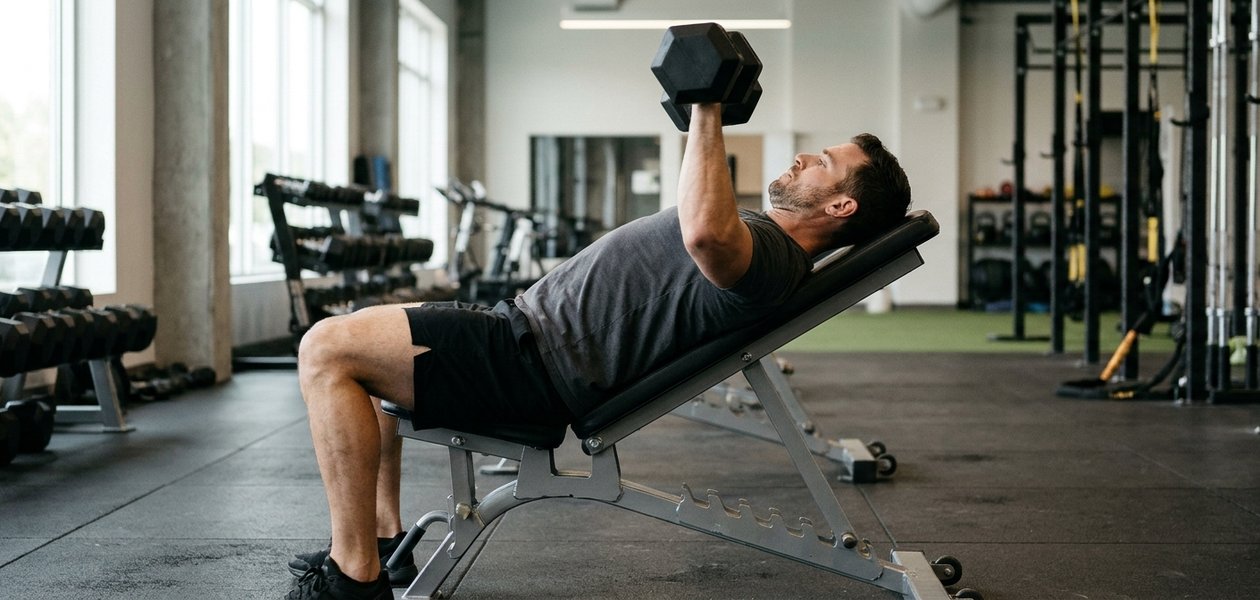
The incline lift works with a pair of dumbbells, a barbell or a machine, and the same few rules hold for all three: a low backrest, shoulder blades pinned to the pad, and a controlled path to the top of the ribcage. Set the backrest too steep and the movement turns into a shoulder press.
Upper Chest, Front Delts and Triceps: What the Incline Press Trains
The pectoralis major, the main mover on an incline bench, has two heads. The clavicular head starts on the inner half of the collarbone and flexes the upper arm, raising it forward, while the larger sternocostal head runs from the breastbone and ribs and pulls the arm across the body.
Tilting the bench adds that forward raise to the pressing path, so the upper fibers take a bigger share of each rep. The front of the shoulder joins in for the same reason: per Cleveland Clinic, the anterior deltoids connect to the collarbone and move the arm forward.
The triceps straighten the elbows to finish each incline rep, and bench angle barely changes their role: in the 2020 study they stayed at about 15% of maximal activation at every setting. Smaller muscles hold the shoulder steady, including the rotator cuff and the serratus anterior, the same stabilizers a flat bench press uses.
The Best Bench Angle for the Upper Chest
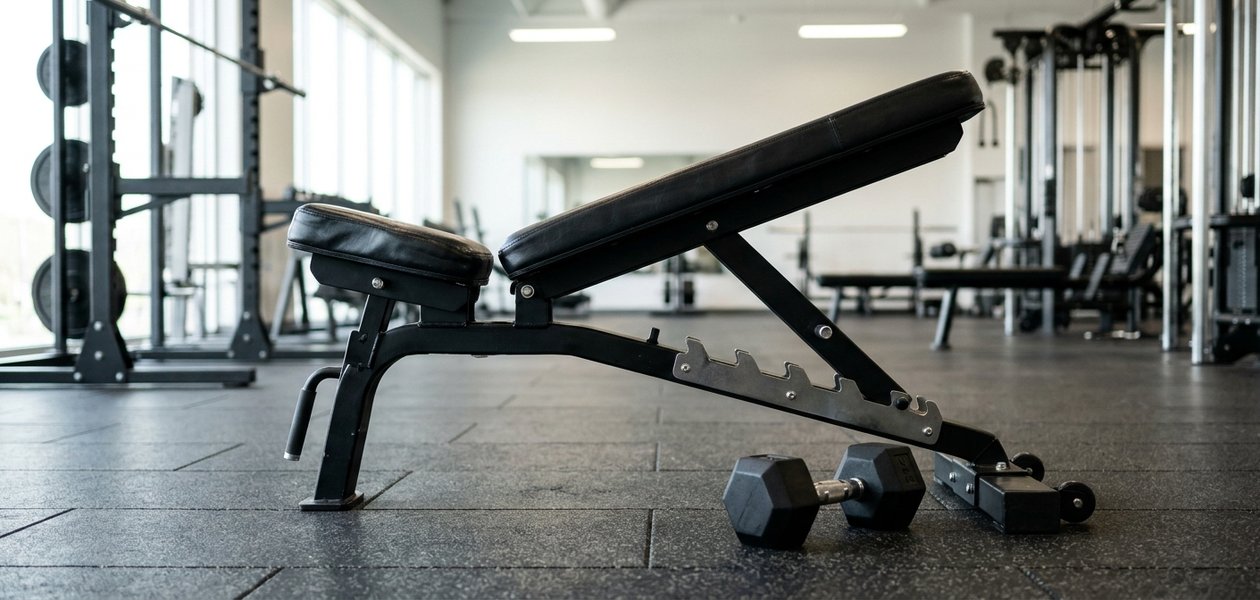
Coaches mostly set an incline bench between 15 and 30 degrees, and the clearest lab data sits at the top of that range. Rodríguez-Ridao and colleagues had 30 trained adults press a barbell at five angles with 60% of their one-rep max, recording each muscle’s activity as a share of its maximum effort.
| Bench angle | Average one-rep max | What the muscle readings showed |
|---|---|---|
| 0 degrees (flat) | 81.4 kg (179 lb) | Upper, middle and lower chest and the front deltoid all worked at similar levels, near 27% |
| 15 degrees | 72.0 kg (159 lb) | Upper chest rose to about 28%; middle and lower chest dropped |
| 30 degrees | 63.3 kg (140 lb) | Upper chest reached its peak, about 30%, with the front deltoid close behind at about 33% |
| 45 degrees | 57.9 kg (128 lb) | Front deltoid clearly ahead of every chest portion |
| 60 degrees | 52.2 kg (115 lb) | Front deltoid at its highest; the lift behaves like a shoulder press |
The upper chest gain from flat to 30 degrees was modest, while the shift toward the shoulders past 30 degrees was clear. That pattern is why many guides stop at 30. The load also falls fast: the group handled about 22% less weight at 30 degrees than flat, so expect to drop the dumbbells or plates by roughly a fifth.
Not every study agrees. An older test on a Smith machine found upper chest activity climbing at 44 and 56 degrees but not at 28, and the 2020 authors suggest the guided bar may explain the gap. For free weights, 30 degrees remains the better supported pick.
How to Do the Incline Dumbbell Press, Step by Step
Dumbbells suit the incline version well because each arm moves on its own and the hands can travel a little deeper than a bar allows. A set goes well or badly from the first second, so the setup matters as much as the rep itself:
- Set the backrest. Raise it to 15 to 30 degrees. If the seat adjusts, lift it a notch so the hips do not slide down the bench mid-set.
- Get the weights in place. Sit with a dumbbell standing on each thigh, then lean back and use a small knee drive to bring them to shoulder height.
- Lock in the shoulders. Plant both feet flat on the floor, pull the shoulder blades back and down into the incline pad, and keep the ribcage lifted.
- Press up and slightly back. Drive the dumbbells until they sit over the shoulders, wrists stacked above the elbows, and stop before they clank together.
- Lower with control. Bring them down to the upper chest, near the collarbone line, with the elbows about 45 degrees from the torso rather than flared straight out.
- Finish safely. After the last rep, pull the dumbbells to the chest and rock up to a seated position with them on the thighs instead of dropping them out to the sides.
Incline Barbell and Machine Versions
A barbell lets a lifter move more weight and track strength from week to week. Grip it slightly wider than the shoulders: wider hand spacing leans on the chest, while a narrow grip shifts more work to the triceps. Lower the bar to the upper chest, not the middle, and press it back over the shoulders.
Heavy incline barbell sets carry a risk dumbbells do not, since a failed rep can pin the lifter under the bar. Use a spotter or set the rack’s safety arms just under the bar’s lowest point before the first set.
On a seated machine, the seat height does the work of the bench angle. Set it so the handles start level with the upper chest; a seat set too low turns the path into an overhead press.
As a rule of thumb, dumbbells suit lifters training alone and anyone evening out a weaker side, the barbell suits tracking strength with a spotter or safety arms, and a machine suits learning the path or pushing hard sets without a spotter.
Incline Press Mistakes That Shift Work to the Shoulders
Lifters who feel incline pressing mostly in the front of the shoulders usually make one of these errors:
- A backrest that is too steep: past 30 degrees, the front deltoid takes over and chest activity drops.
- Shoulders rolling forward: once the shoulder blades leave the pad, the front delts lead each press and the upper chest does less.
- Elbows flared wide: elbows straight out at 90 degrees from the torso instead of the usual coaching cue of about 45 degrees.
- A big lower back arch: lifting the chest high flattens the real angle, so the lift drifts back toward a flat press.
- Bouncing out of the bottom: a fast drop and rebound takes tension off the upper chest; lower under control instead.
- Weights that are too heavy: a load meant for the flat bench breaks form on an incline bench, where strength runs about a fifth lower.
Incline vs Flat Bench Press: Which Builds More Chest?
Both lifts use the same muscle team, so the real question is emphasis. The flat bench spreads the work evenly across the chest and allows the heaviest loads. The incline version trades some of that weight for more upper chest work.
A training study in 47 untrained men put that to the test. For eight weeks, groups trained once a week with flat bench pressing only, incline bench pressing only, or both. Strength gains came out alike, about 10 kg on a flat isometric test and 11 kg on an incline test, in every group.
Muscle size told a slightly different story. At the upper chest measuring site, the group that trained only on the incline bench gained about 0.62 cm more thickness than the flat-only group. The authors concluded that flat, incline or combined training builds similar general strength.
The practical answer is to keep both. A program built around the flat dumbbell version can add incline sets on the same day or the next session to bring up the top of the chest.
Sets, Reps and Weight for Upper Chest Pressing
The CDC guidelines for adults call for muscle-strengthening work at least 2 days a week, covering every major muscle group, the chest included. Incline pressing fits on either of those days.
For the incline chest press itself, the training study above used 4 to 6 sets of 8 to 12 reps once a week, and that was enough for clear strength gains in men who had not lifted for at least six months.
Load is the biggest lever. A 2017 review of 14 bench press studies found exercise intensity, the weight as a share of the one-rep max, was the factor that changed muscle activity most. Pick a weight that makes the last two reps of each set hard while form holds.
Order is a choice. Doing the incline press first on chest day gives the upper chest the freshest effort, while lifters chasing a heavy flat bench can do it second, as the combined group in that training study did.
