
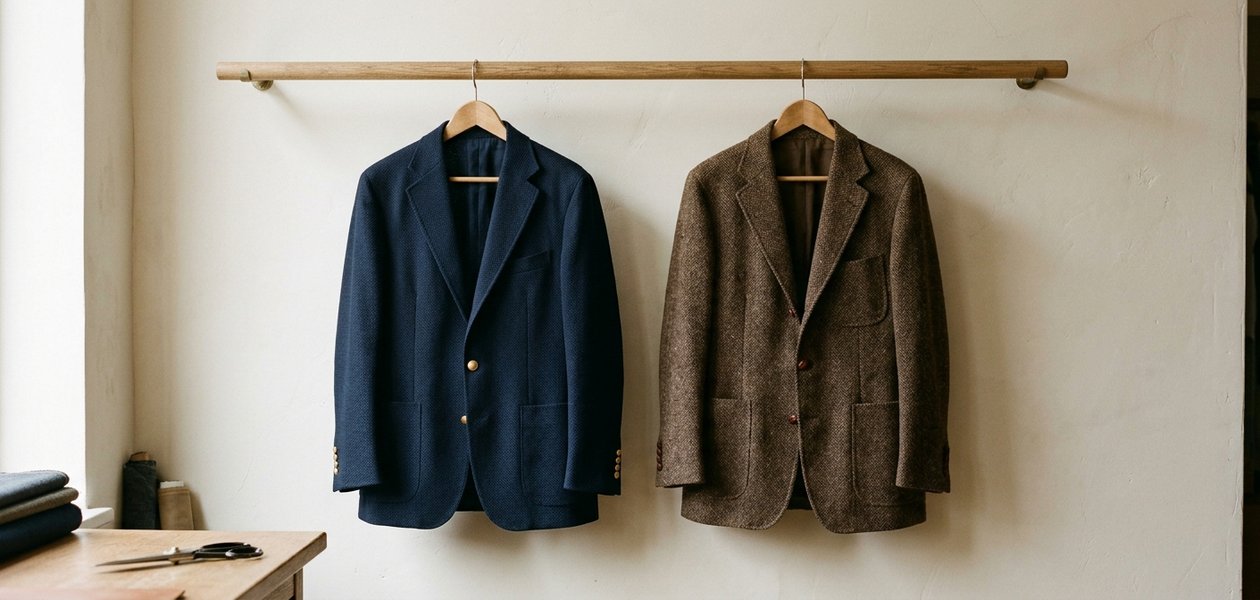
That last point separates both of them from a suit jacket, which belongs to a matched set. A blazer and a sport coat are each made to stand alone over odd trousers, chinos or dark denim. The blazer leans plain and polished; the sport coat leans rugged, roomy and freer with color and pattern.
What Makes a Jacket a Blazer
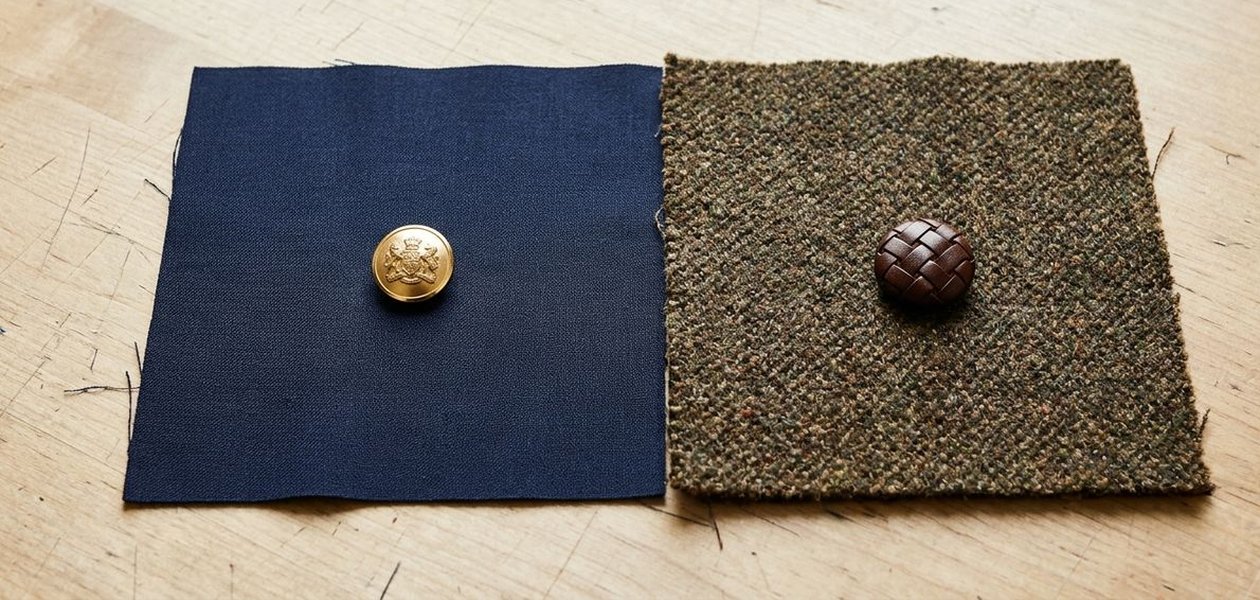
The modern blazer is defined by plain cloth and contrasting buttons. Navy is the classic color, with charcoal, black and camel close behind, and the buttons are usually brass, gold-toned, silver or pewter. Those metal buttons are the quickest visual tell.
Blazer cloth is usually a smooth worsted wool, a hopsack weave or, for summer, linen or cotton. The Woolmark Company explains that worsted yarn mainly uses fleece wool with the longest fibers and makes the flatter, lighter and smoother fabrics used in traditional tailoring. That smooth surface is why a blazer looks crisp and sits close to a suit.
Most blazers carry some structure: a light canvas, modest shoulder padding and a clean line from shoulder to hem. A blazer can be single breasted with two buttons or double breasted, and the double-breasted navy version with naval-style buttons is sometimes called a reefer.
School, club and regimental blazers keep an older tradition alive with bright stripes, piping in club colors or a badge on the breast pocket. Away from those circles, the plain navy blazer is the everyday form of the jacket.
What Makes a Jacket a Sport Coat
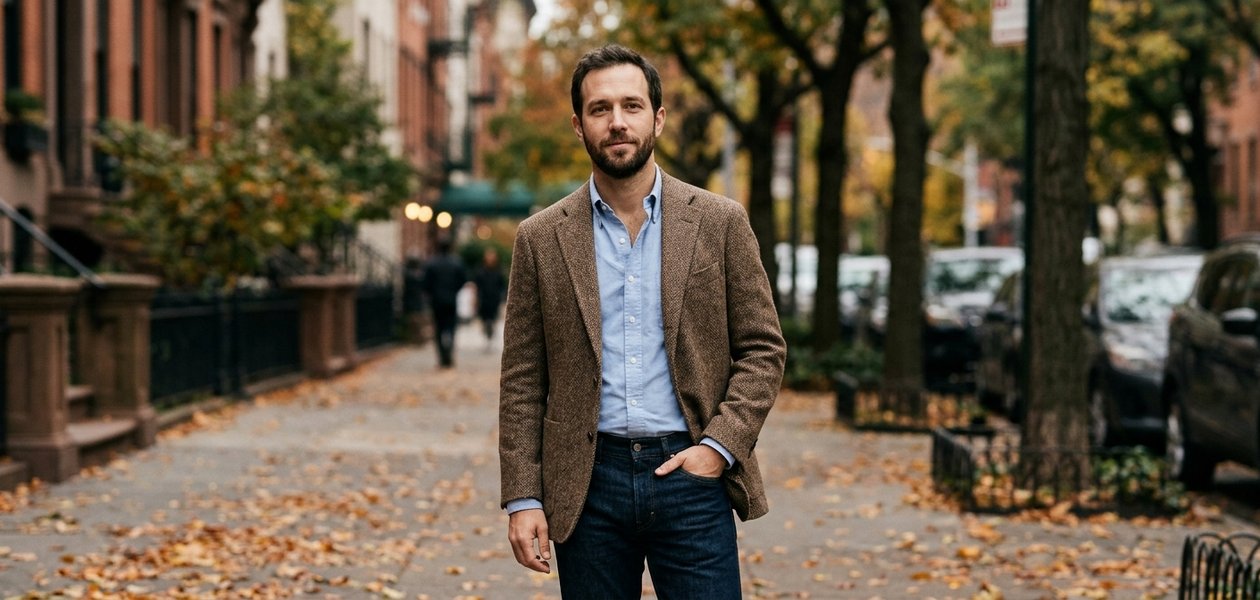
A sport coat, called a sports jacket in British English, is a tailored jacket made to be worn with trousers in a different cloth. Its fabrics show texture or pattern: tweed, herringbone, houndstooth, windowpane check, glen plaid, flannel, corduroy and, for warm months, linen.
Many of those sport coat cloths are woollen rather than worsted. Woolmark notes that woollen yarn is spun from the shorter fibers of the fleece and goes into thick, heavyweight fabrics suited to warm winter jackets, which fits the soft, slightly fuzzy surface of many tweed and flannel sport coats.
Harris Tweed, a classic sport coat cloth, even has a legal definition. Under the Harris Tweed Act 1993, the Harris Tweed Authority states, the cloth must be handwoven by islanders at their homes in the Outer Hebrides, finished there and made from pure virgin wool dyed and spun on the islands.
The Authority replaced the Harris Tweed Association, set up in 1909, and stamps genuine cloth with its Orb mark.
The cut of a sport coat is usually softer and roomier than a blazer’s, with less padding and space for a sweater or turtleneck underneath. Sporting details such as suede elbow patches, leather buttons, a ticket pocket or a pleated action back all point to a sport coat.
Fabric, Color, Buttons and Formality Compared
The table sets the two jackets beside the suit jacket, the third piece men most often mix up with them.
| Detail | Blazer | Sport coat | Suit jacket |
|---|---|---|---|
| Formality | Middle: business casual and dressy casual | Lowest: smart casual and weekends | Highest: business formal |
| Color | Solid, classically navy; also charcoal, black, camel | Browns, greens, grays and blues, often mixed | Navy, gray, charcoal and other quiet tones |
| Cloth | Smooth worsted, hopsack, flannel; linen in summer | Tweed, herringbone, flannel, corduroy, linen | Fine worsted wool cut to match its trousers |
| Pattern | Plain, or club stripes | Checks, plaids, herringbone, houndstooth | Plain or a subtle stripe or check |
| Buttons | Contrasting metal: brass, gold-toned, silver | Horn, leather or plastic | Horn or plastic in a matching tone |
| Structure | Light to moderate, crisp shoulders | Soft and roomier, made for layering | Structured, fitted over a dress shirt |
| Sold with trousers | No | No | Yes |
| Pairs with | Gray flannels, chinos, dark jeans | Jeans, chinos, cords, flannels | Its own trousers only |
Where the Suit Jacket Sits Above Both
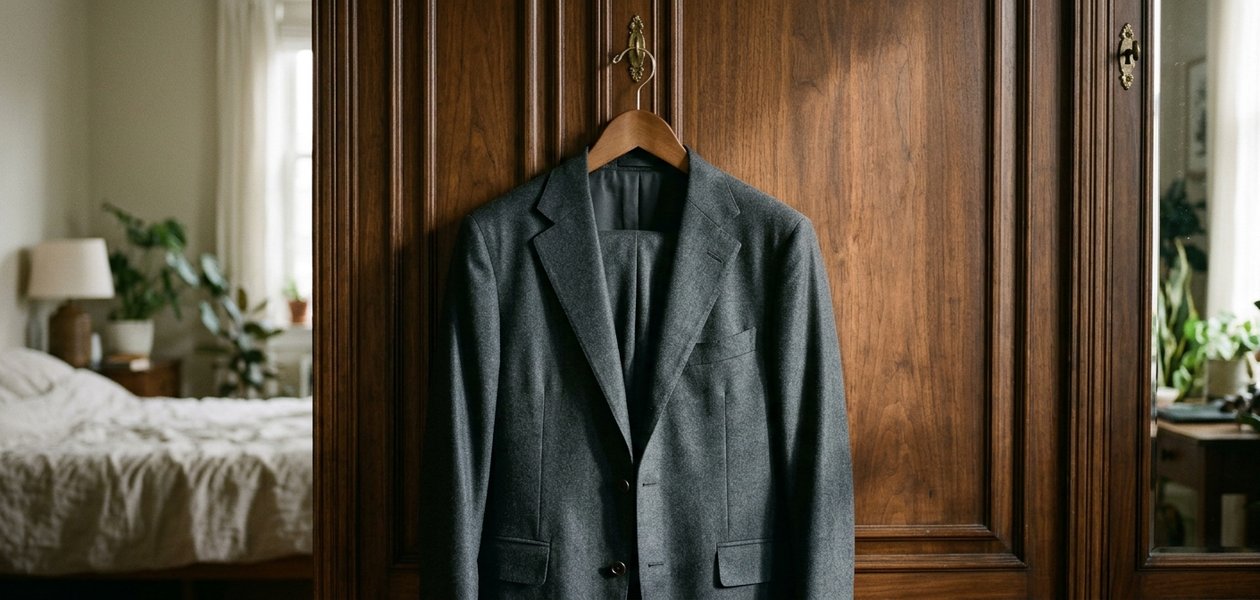
A suit jacket is half of a matched set, cut from the same cloth as its trousers. The Emily Post Institute’s attire guide from casual to white tie describes business formal as a suit jacket with matching pants, while it lists a seasonal sport coat or blazer with slacks or khakis under business casual.
That gives a simple ladder: the suit jacket at the top, the blazer in the middle and the sport coat at the bottom. Black tie and white tie sit above all three and call for a tuxedo or a tailcoat, so neither a blazer nor a sport coat stands in for them.
Wearing a suit jacket on its own rarely works. Its fine, smooth cloth looks out of place beside jeans or chinos, and the jacket and trousers age unevenly when one is worn and cleaned more often than the other. Menswear writers call the result an orphaned suit jacket.
Spotting the Difference in 30 Seconds
Five checks, taken in this order, sort almost any jacket on a rack in under 30 seconds.
- Look for matching trousers. A jacket sold with trousers of the same cloth is a suit jacket, whatever its color.
- Check the buttons. Brass, gold-toned or silver buttons on a solid jacket mark a blazer.
- Read the cloth. A smooth, flat weave suggests a blazer; visible texture such as tweed, brushed flannel or corduroy wales suggests a sport coat.
- Find the pattern. Checks, plaids, herringbone and houndstooth belong to sport coats, while blazers stay plain apart from club stripes.
- Press the shoulder. A soft, lightly padded shoulder and a roomier body lean toward a sport coat; a crisper, built-up shoulder leans toward a blazer.
Plenty of modern jackets blur these lines. An unstructured navy hopsack jacket with horn buttons is sold as a blazer in most shops, yet a traditional tailor might call it a sport coat. In practice, how formal the jacket looks matters more than the name on the tag.
When a Blazer Is the Better Choice

A blazer earns its place wherever a man wants to look polished without a full suit. Emily Post lists a sport coat or blazer with slacks for dressy casual occasions such as networking after work, fundraisers and dinner at a nice restaurant, and the blazer is the dressier of the two.
- Business casual offices: a navy blazer over a dress shirt with gray trousers or chinos, tie optional.
- After-work events: the same blazer with an open collar, a pocket square and leather loafers.
- Dinner at a good restaurant: a charcoal or navy blazer with a light blue shirt and dark wool trousers.
- Travel days: a dark blazer dresses up jeans on the plane and still looks right at a meeting that evening.
The classic blazer outfits are easy to copy: navy blazer, mid-gray flannel trousers, a white or light blue shirt and brown leather shoes, or navy blazer, tan chinos, an oxford shirt and loafers.
For the office, Chivalry Men’s guide to what business casual means for men sets the baseline, and its piece on pairing a tailored jacket with dark denim covers the jeans side.
When a Sport Coat Is the Better Choice
A sport coat shines when the setting is relaxed but a hoodie would look careless. Its texture sits naturally next to denim, corduroy and knitwear, so it handles the casual end of smart casual better than a crisp blazer does.
- Date nights: a brown tweed or gray herringbone sport coat over a knit polo or oxford shirt, with dark jeans and suede chukka boots.
- Weekend gatherings: a corduroy or unlined linen sport coat over a plain T-shirt or crewneck sweater.
- Relaxed offices: a checked sport coat with solid trousers in navy, gray or tan, so only one piece carries pattern.
- Cold-weather plans: a flannel or tweed sport coat with a turtleneck, gray wool trousers and leather boots.
A patterned sport coat stays calm when it is the only patterned piece, or when the shirt’s pattern is much smaller than the jacket’s. Solid trousers in a color pulled from the jacket’s weave tie the outfit together.
Cloth Weight and the Seasons
Formality is only half the choice, because the weight of the cloth decides comfort. Heavy tweed and flannel hold warmth outdoors in the cold yet can feel stuffy in a heated restaurant, while linen breathes in summer and gives little warmth once the sun goes down.
- Fall and winter: tweed, flannel and corduroy, the natural ground of the sport coat.
- Spring: lighter worsted, hopsack and cotton, which suit a blazer well.
- Summer: linen, cotton and seersucker, often half lined or unlined in either style.
- Year round: a mid-weight navy hopsack or worsted blazer, the most versatile single jacket a man can own.
First Jacket: The Navy Blazer, Then a Sport Coat
For a man buying his first tailored jacket, a navy blazer covers the most ground. It works with gray trousers for business casual, with chinos for dinner and with dark jeans on the weekend, and it rarely looks out of place at an event that asks for a jacket.
The sport coat makes the better second jacket, or the first one for a man whose week is mostly casual. A brown, gray or olive tweed or herringbone works with jeans and chinos through the colder months, and a linen or cotton version covers the summer.
Fit matters more than the label on either jacket. The shoulder seam should end where the shoulder does, the sleeve should show a little shirt cuff and the hem should cover the seat. A tailor can shorten sleeves easily but can rarely fix shoulders that are too wide.
How Rowing Crews Named the Blazer
The Lady Margaret Boat Club, the rowing club of St John’s College, Cambridge, says the word blazer began with its own bright red club jackets, named for their blazing color. The club was founded in 1825, about 200 years ago, so the name was born on the river rather than in any office.
A letter to the London Daily News in August 1889 already noted that the word had spread from that one club’s red flannel jacket to colored flannel jackets for cricket, tennis, boating and the seaside, as the encyclopedia entry on the blazer quotes it.
The same entry notes that the popular HMS Blazer story, in which a naval captain dressed his crew in smart jackets for an inspection, is not borne out by contemporary sources.
The Fashion History Timeline at the Fashion Institute of Technology describes the 1880s blazer as a single-breasted lounge jacket, often in bright stripes, worn with light flannel trousers for rowing, tennis, cricket and the seaside. The same page lists double-breasted jackets known as reefers as another choice for summer sports and picnics in that decade.
How Shooting and Riding Shaped the Sport Coat
The sport coat comes from the British countryside. The same FIT timeline records that in the 1880s the Norfolk jacket, with its pleated back and belted waist, was the most common choice for shooting and country activities, worn with loose knee breeches and gaiters.
Those outdoor jackets needed hard-wearing cloth and room to move, which is where the sturdy tweeds, roomy cut and practical pockets of a sport coat come from. Shooting jackets added a leather patch on the shoulder against a gun’s recoil, and hacking jackets were cut for riding.
By the 1930s, FIT’s timeline for that decade notes, blazers and sports jackets worn with flannel trousers and open-necked shirts had become popular men’s styles borrowed from sport. Both jackets have kept moving from the field and the river into everyday dress ever since, which is why their names now overlap on shop labels.
