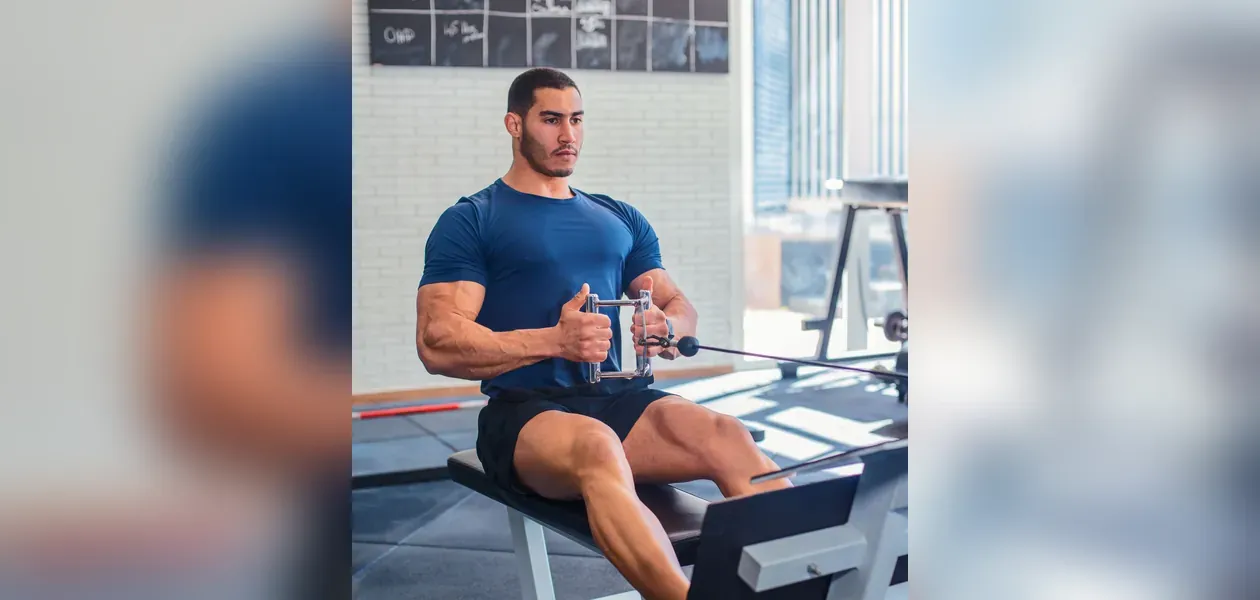
The seated cable row is a back exercise done on a low cable station: you sit with your feet braced, hold a handle with straight arms and pull it to your stomach while squeezing your shoulder blades together. It mainly trains your lats, rhomboids and middle traps, with your biceps and rear delts helping.
Because the bench and footplate hold you in place, you can load your upper back without holding a bent-over position. That makes it one of the easiest rows for building back muscle with strict form.
TL;DR
- The seated cable row is a back exercise where you sit with your feet braced, pull a handle from straight arms to your stomach and squeeze your shoulder blades together while your torso stays still.
- It mainly works your lats, rhomboids and middle traps, with your lower traps, rear delts, biceps and forearms helping.
- Your elbow path sets the target: a close V-handle grip with tucked elbows trains your lats hardest, while a wide grip with flared elbows shifts the work to your traps and rear delts.
- Sit upright instead of leaning back: in a 2022 study, leaning back 20 degrees produced the most upper trap activity and the least middle and lower trap activity.
- Avoid swinging, rounding, shrugging and going too heavy, and start with 3 to 4 sets of 8 to 12 reps once or twice a week.
How to Do a Seated Cable Row
Use a seated row station with a close-grip V-handle, held with your palms facing each other.
Set Up the Machine
Pick a weight you can pull for 10 clean reps. Sit with your feet on the platform and your knees slightly bent, then grab the handle and slide back until your arms are straight and the weight lifts off the stack. Sit tall, chest up, shoulders down, and brace your abs.
Step-by-Step Form
- Start long. Let your arms straighten and your shoulder blades reach toward the machine.
- Pull with your elbows. Exhale and drive your elbows back along your sides, bringing the handle toward your belly button.
- Squeeze. Pinch your shoulder blades together as the handle touches your stomach and hold for one second.
- Return slowly. Inhale and let the handle travel forward over two to three seconds.
Your torso stays still; only your arms and shoulder blades move. My own cue is to drive my elbows toward my back pockets instead of pulling with my hands, which keeps my biceps from taking over.
Seated Cable Row Muscles Worked
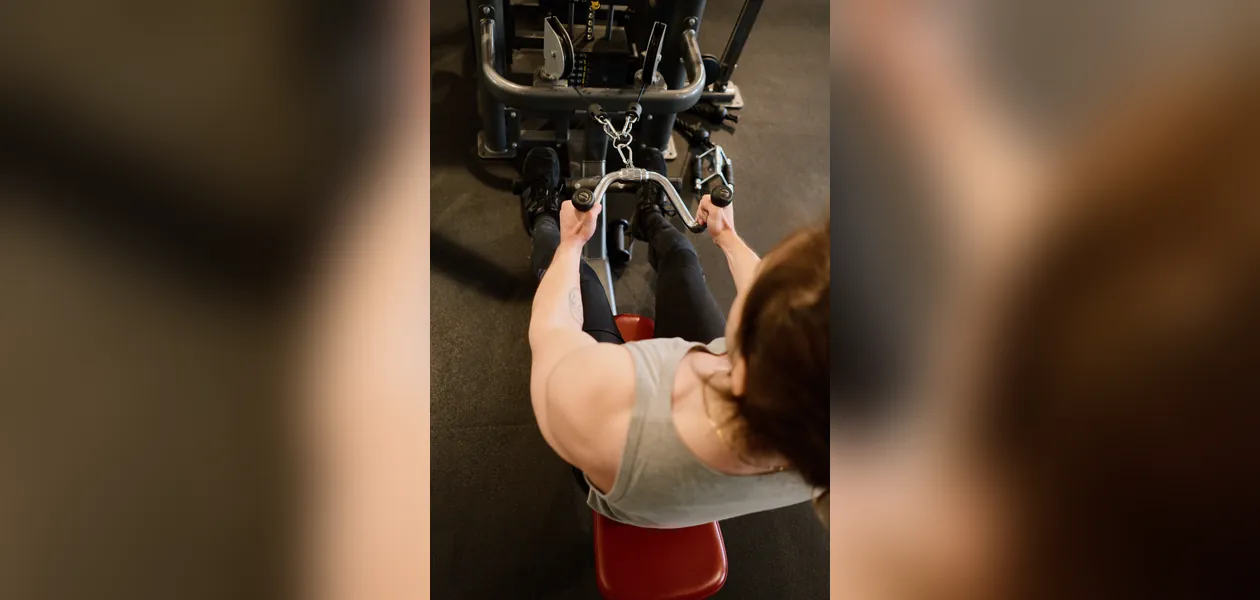
The seated cable row is a compound pull, moving both your shoulder and elbow joints. These muscles do the work:
- Latissimus dorsi. Your lats, the largest back muscles, pull your upper arms back toward your sides.
- Rhomboids and middle traps. They pull your shoulder blades together at the end of each rep.
- Lower traps. They draw your shoulder blades down and stop you from shrugging.
- Rear delts. The back of your shoulders helps pull your arms behind you.
- Biceps and forearms. They bend your elbows and hold the handle; a hammer curl adds direct arm work.
Your spinal erectors and abs act as stabilizers, keeping your torso upright.
Benefits of the Seated Cable Row
- A thicker, stronger back. It loads the lats and mid back in one controlled movement.
- Less strain on your lower back. The seat supports you, so you never hold the hinged position a bent-over barbell row needs.
- Balance for pressing. A horizontal pull offsets bench presses and push-ups.
- Easy to progress. Adding load is as simple as moving a pin.
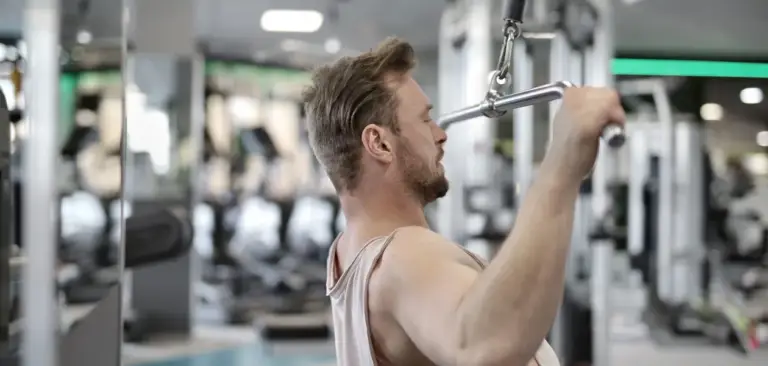
It pairs well with the lat pulldown, which trains your lats from overhead while the row works them from in front.
Which Grip Should You Use?
Your elbow path matters more than the handle. In a 2023 study of 21 recreationally trained men and women, rows with the elbows close to the body produced the most force and lat activity, while elbows flared to 60 or 90 degrees shifted the work to the traps and rear delts.
- Close neutral grip (V-handle). Elbows stay at your sides: the best choice for your lats and the heaviest weight.
- Wide overhand grip (long bar). The bar comes to your lower chest, with less weight and more upper back work.
- Underhand grip (straight bar). Palms up with elbows tucked brings in more of your biceps than an overhand grip.
A 2025 study of 14 resistance-trained men found the same split: the narrow grip drew more lat activity, the wide grip more trapezius activity. Use both over time.
Should You Lean Back on a Seated Cable Row?
Only a little, if at all. Sit upright for the pull and let your torso tip forward slightly at the stretch, but don’t rock back to finish.
In a 2022 study of 23 healthy young adults doing a modified seated cable row, leaning back 20 degrees produced the most upper trap activity and the least middle and lower trap activity.
The lean turns part of the row into a shrug. If you have to swing back to finish a rep, the weight is too heavy.
Common Seated Cable Row Mistakes
- Swinging your torso. Rocking turns the row into a momentum lift and shifts the load to your lower back.
- Rounding your back. A slight hip hinge at the stretch is fine; a hunched lower back is not.
- Shrugging. Shoulders creeping toward your ears mean your upper traps are doing your mid back’s job.
- Cutting the range short. Straighten your arms fully and bring the handle all the way in.
- Letting the weight crash. The lowering phase builds muscle too, so control it.
- Going too heavy. Most of these errors start here.
Sets, Reps and Weight for the Seated Cable Row
For most men, 3 to 4 sets of 8 to 12 reps, once or twice a week, is a solid start. Choose a weight that leaves one or two reps in the tank on your last set.
A 2021 review in the journal Sports concluded that muscle growth can be achieved across a wide spectrum of loads, while heavy loads still work best for maximal strength.
- For muscle size: 3 to 4 sets of 8 to 15 reps.
- For strength: 3 to 5 sets of 4 to 8 heavier reps, with longer rests.
- For beginners: 2 to 3 light sets of 10 to 12 reps while you learn the movement.
Seated Cable Row Variations and Alternatives
Once the standard row feels solid, try these changes:
- Single-arm cable row. A D-handle works each side alone and makes your core resist twisting.
- Wide-grip cable row. A long bar and flared elbows focus on your upper back.
- Paused row. Holding the squeeze for two to three seconds makes a lighter weight feel heavy.
No Cable Machine? Try These Alternatives
- Resistance band seated row. Loop a band around your feet, sit on the floor and row it to your stomach.
- Chest-supported dumbbell row. Lie face down on an incline bench and row two dumbbells.
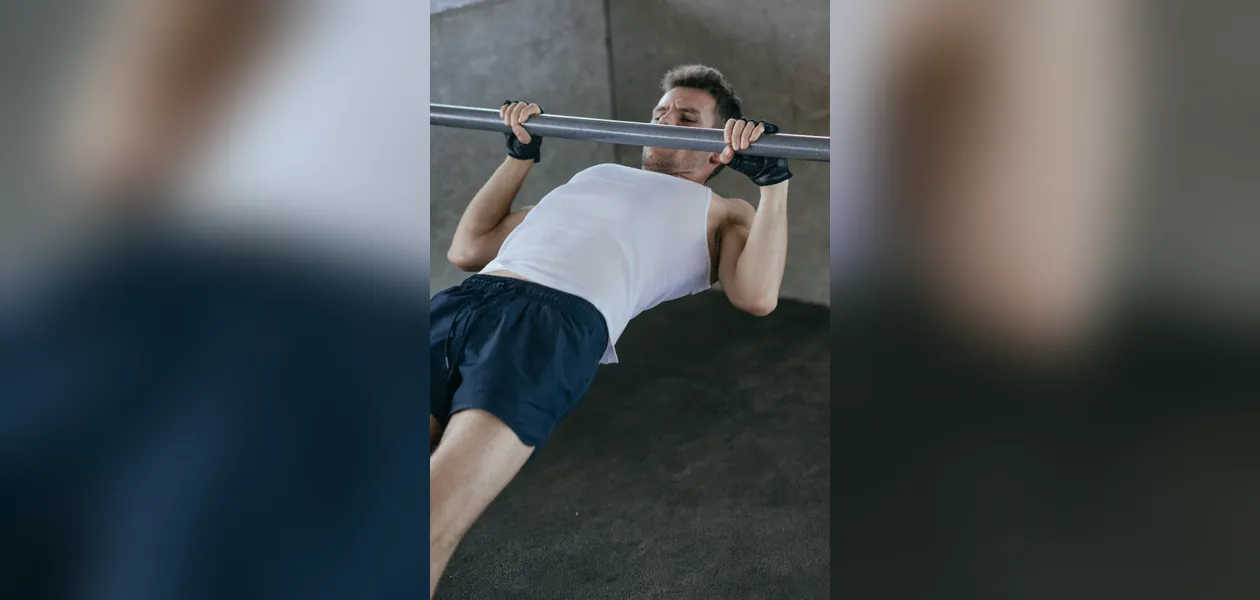
- Inverted row. Hang under a waist-high bar and pull your chest up to it.
FAQ
What muscles does the seated cable row work?
Mainly your lats, rhomboids and middle traps. Your lower traps draw your shoulder blades down, your rear delts help pull your arms back, and your biceps and forearms bend your elbows and hold the handle. Your spinal erectors and abs work as stabilizers, keeping your torso upright.
Should you lean back on a seated cable row?
Only slightly, if at all. Sit upright for the pull and let your torso tip forward a little at the stretch. In a 2022 study, leaning back 20 degrees produced the most upper trap activity and the least middle and lower trap activity. If you have to swing back to finish, the weight is too heavy.
Which grip is best for seated cable rows?
A close neutral V-handle grip suits most lifters, because it keeps your elbows at your sides, trains your lats hardest and lets you lift the most weight. A wide overhand bar shifts the work to your traps and rear delts, and an underhand grip brings in more of your biceps.
Is the seated cable row better than the bent-over row?
Neither is better overall; they suit different needs. The seated cable row supports you on a bench, so you can load your lats and mid back without holding a hinged position. A bent-over barbell row needs you to hold that hinge, which puts more strain on your lower back.
How many sets and reps should I do for seated cable rows?
Start with 3 to 4 sets of 8 to 12 reps, once or twice a week, using a weight that leaves one or two reps in the tank. For muscle size, 8 to 15 reps works well; for strength, do 3 to 5 sets of 4 to 8 heavier reps with longer rests.
Sources
- Effect of Different Grip Position and Shoulder-Abduction Angle on Muscle Strength and Activation During the Seated Cable Row, International Journal of Strength and Conditioning
- High-Density Surface Electromyography Excitation of Prime Movers in the Narrow vs. Wide Grip Seated Row Exercise, Journal of Human Kinetics
- Effect of Trunk Position on Trapezius Muscle Activity and Ratio during Performing Modified Seated Cable Row Exercise, Journal of Musculoskeletal Science and Technology
- Loading Recommendations for Muscle Strength, Hypertrophy, and Local Endurance: A Re-Examination of the Repetition Continuum, Sports (MDPI), via PubMed Central